Bumble Statistics 2026: The Hard Truth About Dating App Numbers
50M users, 80M daily swipes, and a 3% match rate for men.
Key Bumble Statistics You Need to Know
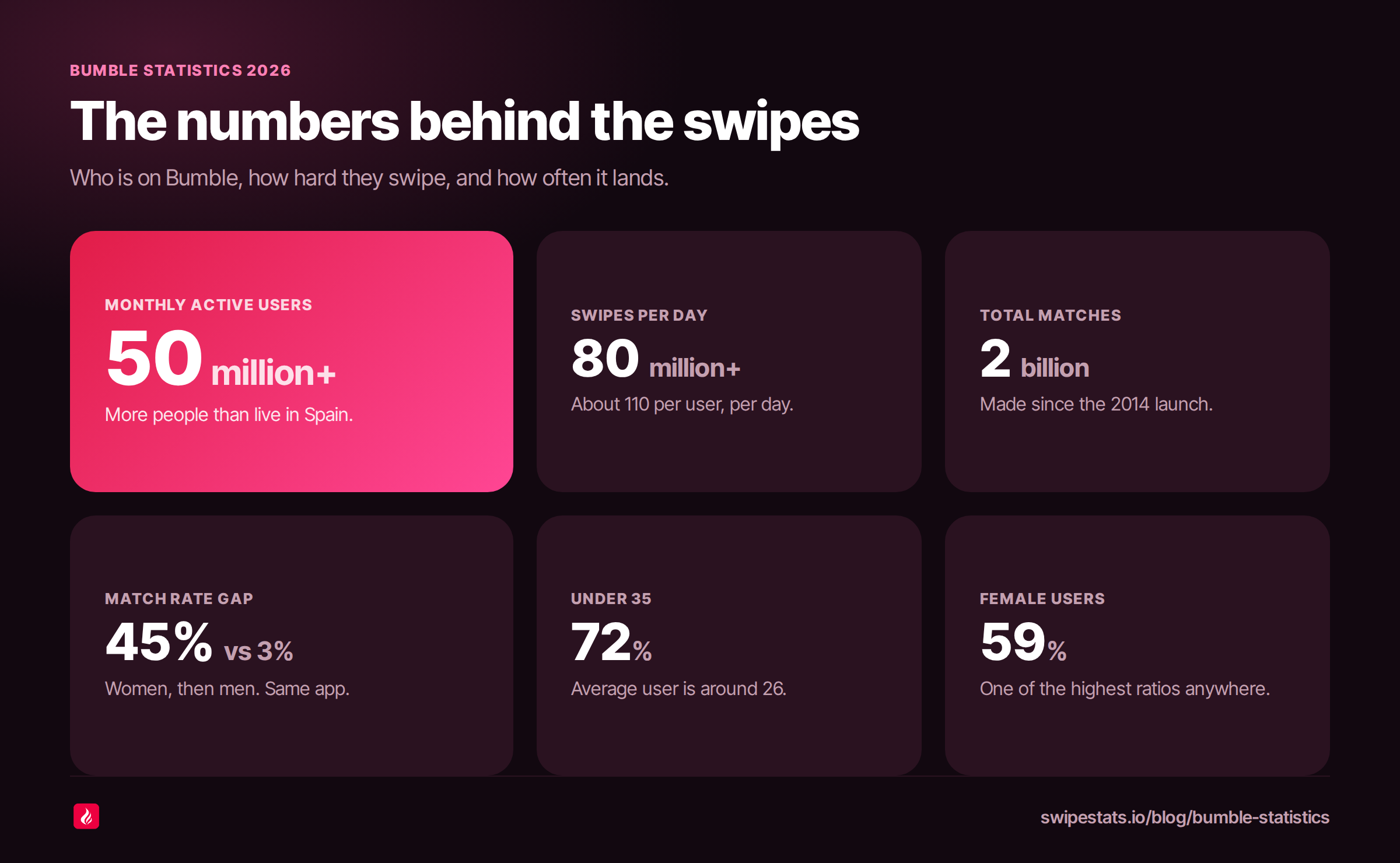
- 50 million monthly active users globally - that's more people than the entire population of Spain
- 3.6 million paying users as of 2026, representing a 16% year-over-year decrease
- 72% of users are under 35, making this overwhelmingly a young person's game
- 59% of Bumble users are female - one of the highest ratios in the dating app world
- 2 billion total matches have been made since the app launched
- 80+ million swipes daily - that's a lot of thumb exercise
- $246 million in Bumble app revenue for the third quarter of 2025
- Women have a 45% match success rate, while men sit at just 3%
- 91% of users over 22 have a bachelor's degree or higher
- 20% of online couples who got married met on Bumble, according to The Knot's 2024 data Now let's break all of this down and figure out what it actually means for your dating life.
How Many Users Does Bumble Have? (The Real Numbers)
This is the question everyone asks first, and for good reason. The number of Bumble users directly affects your odds of finding someone. More people means more potential matches, right? Well, sort of.
Total Active Users
Bumble currently boasts 50+ million monthly active users as of 2026. To put that in perspective, when Bumble launched in 2014, they had about 1 million users. The growth trajectory has been nothing short of remarkable.
Paid Users: Who's Actually Opening Their Wallet?
Here's where things get interesting. Of those 50+ million monthly active users, only 4.1 million are paying customers - that's roughly 4.6% of the user base. This 11.5% year-over-year growth in paying users is impressive, up from 2.3 million in Q1 2023. But it also means the vast majority of people are either on the free tier or strategically timing their premium subscriptions around specific dating pushes.
Bumble Users by Country
Who uses Bumble? Geographically, it's a truly global phenomenon, but some markets dominate:
- United States: ~7.65 million monthly visitors (12.2% of global traffic)
- India: ~4.1 million monthly users (15.7% of traffic) - actually the largest market by percentage
- Germany: ~2.9 million monthly users (10.9% of traffic)
- United Kingdom: ~1.5 million monthly users
- Canada: ~1.4 million monthly users
- Australia: Over 2 million registered users
- Indonesia: 1.47 million monthly visitors North and Latin America combined contribute 56.61% of all worldwide downloads, making the Americas the dominant geographic market. But India's massive user base shows that Bumble's appeal transcends Western dating culture.
Bumble User Demographics: Who's Actually Using This App?
Understanding who uses Bumble tells you a lot about your potential dating pool. The demographics are... enlightening.
Gender Breakdown
Unlike most dating apps where men outnumber women significantly, Bumble's unique positioning has attracted a more balanced - and in some ways, female-dominated - user base. Current Bumble data shows:
- Female users: 59% (some sources cite 46-55%)
- Male users: 41% (some sources cite 45-54%) This represents one of the most female-friendly dating app demographics in the industry. The "women message first" feature isn't just a gimmick - it's fundamentally shaped who shows up to use the platform.
Age Distribution
Bumble skews young. Very young:
Age Group by Percentage of Users
- 18-24: 31.4%
- 25-34: 31.1%
- 35-44: 21.1%
- 45-54: 12.2%
- 55-64: 4.2%
- 65+: 1.1% The key takeaway: 72% of Bumble users are under 35, with an average user age of approximately 26. If you're over 45, you're competing in a pretty thin market on this platform. The 18-29 age bracket alone accounts for 51% of all American Bumble users.
Education and Income Levels
Here's something that might surprise you: Bumble users are remarkably educated. A striking 91% of users over age 22 hold at least a bachelor's degree, with 24% holding postgraduate degrees. This isn't your average dating pool - it's basically a graduate school mixer.
Income-wise, 94.3% of surveyed Bumble users earn between $40,000 and $80,000 annually, which aligns closely with the average U.S. income. Only 3.4% earn over $120,000, meaning the app attracts solidly middle-class professionals rather than an ultra-wealthy crowd.
Bumble Usage Statistics: How People Actually Use the App
Downloading an app is one thing. Actually using it is another. The Bumble user statistics on engagement tell an interesting story about modern dating behavior.
Daily Engagement and Swipe Data
12.3 million daily active users are swiping on any given day
49% of users use the app daily
35.5% of Android users in the US access Bumble every single day
Over 80 million swipes happen daily on the platform
The average user swipes 110 times per day (that's a lot of snap judgments)
Users spend an average of 24-62 minutes daily on Bumble, depending on which study you cite. Either way, that's a significant time investment - and probably why your screen time reports are so depressing.
The Brutal Truth About Match Rates
Here's where we get real. The Bumble swipe data reveals a massive disparity between genders:
- Women's match success rate: 45% - nearly half of their likes turn into matches
- Men's match success rate: 3% - yes, you read that right. Three percent.
- Bumble's overall match rate: 5.75%, compared to Tinder's 16.5% Average message response rate: 26%
This 15:1 disparity in match rates reflects Bumble's female-first design philosophy. Women have choice; men have to stand out. And even when you do match, approximately 70% of matches stall before plans are ever made, with conversations typically dying after just 2-5 messages.
Some helpful tidbits: women with linked Instagram accounts receive 6.9% more matches, and women are 18% more likely to get matches during weekends. Peak activity happens between 6 p.m. and 10 p.m., especially Sunday through Thursday.
Message Volume
Despite the match rate challenges, people are definitely talking. Over 9 billion messages were exchanged globally in 2021 alone - a 40% increase from 2020. The platform has facilitated over 2 billion total matches since inception. The highest message exchanges occur between October and early November, apparently because everyone wants a cuddle buddy before the holidays.
How Does Bumble Make Money?
Let's talk about the money. Because at the end of the day, understanding how does Bumble make money tells you a lot about why the app works the way it does.
Revenue Numbers
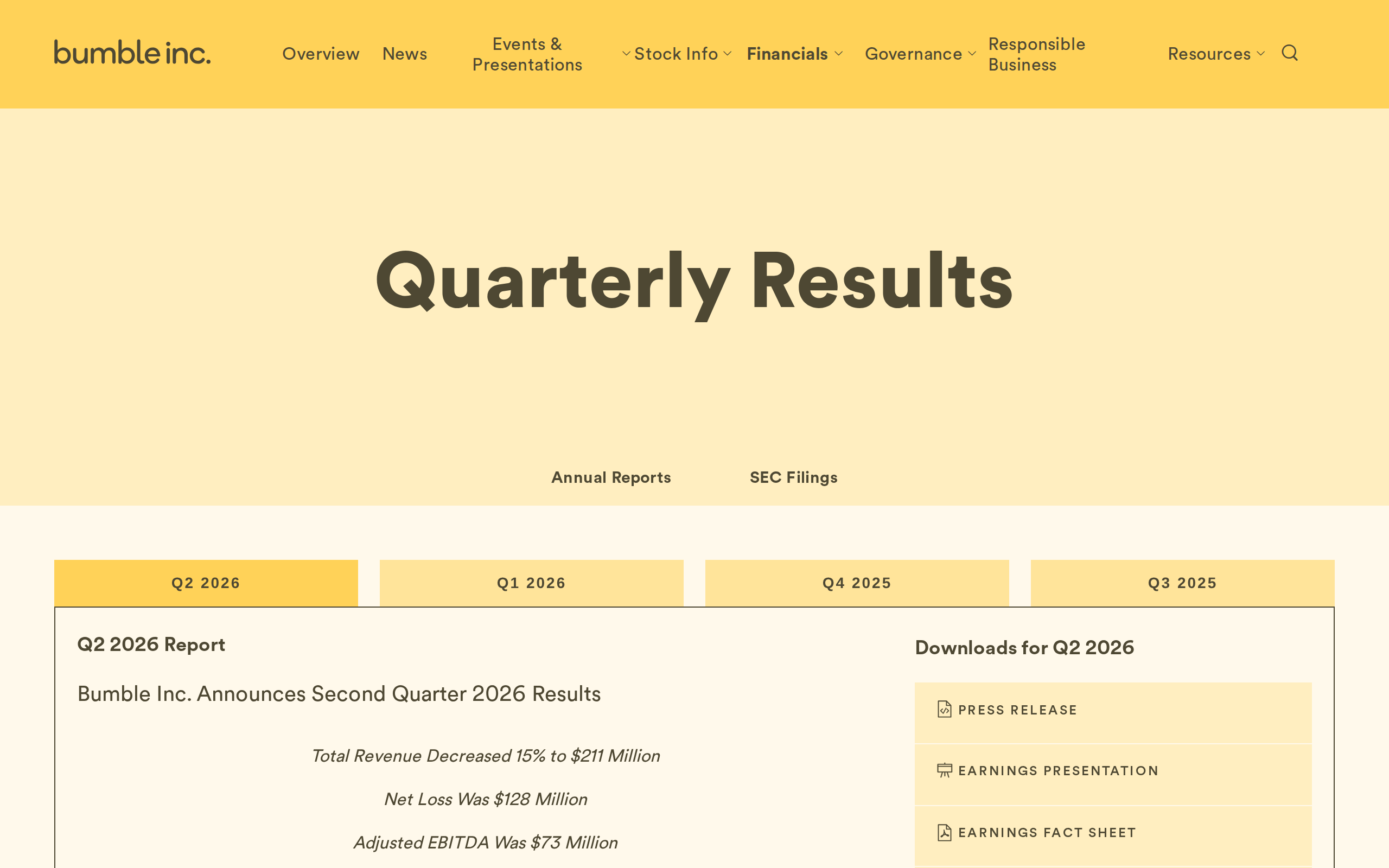
- Total Bumble revenue Q3 2025: $246 million (10% decrease from 2024)
- Bumble app revenue specifically: $866.3 million (3% increase from 2023)
- Net app revenue (after store fees): $199 million as of Q3 2025
- Average revenue per paying user: $21.23 for full year 2024 So is Bumble profitable? The company went public in 2021 and has been growing revenue steadily. 50% of Bumble's revenue comes from North and Latin America, with Europe as the second most profitable market. Approximately 61.7% of U.S. net revenue came from iOS app purchases in the first half of 2024.
The Bumble Business Model
Bumble operates on a freemium model - basic swiping is free, but premium features cost money. The subscription tiers include:
- Bumble Boost (~$16.99/month): Unlimited swipes, backtrack, extend matches, weekly spotlight and superswipes
- Bumble Premium (~$54.99/month): All Boost features plus "Liked You" feature, advanced filters, travel mode, rematch, and incognito mode
- Bumble Premium+ (~$79.99/month): Enhanced visibility and additional perks (availability varies by market) Discounts are available for longer subscription terms (3-6 months). The business model is straightforward: give people a taste of the dopamine hit that comes from matching, then charge them for features that increase their odds. It's brilliant. And apparently, 4.1 million people agree.
Bumble Market Share and Valuation
How much is Bumble worth, and where does it stand against the competition?
Bumble commands approximately 24-26% market share in the U.S. dating app market - nearly tied with Tinder, which holds about 25%. This makes it the second most downloaded dating app in the United States, followed by Hinge.
Globally, Bumble was the second most downloaded dating app worldwide in June 2024. With 16.8 million downloads in 2024 (expected to reach 21.2 million by end of 2026) and app downloads increasing 27% worldwide year-over-year, Bumble's market position remains strong.
Since its IPO in 2021, Bumble has established itself as a publicly traded company with over 600 full-time employees operating across 90+ countries. The Bumble valuation fluctuates with market conditions, but the core business - with its billion-dollar annual revenue - shows no signs of slowing down.
Does Bumble Actually Work? Relationship Outcomes
Alright, here's the question that actually matters: does all this swiping lead anywhere meaningful?
The data is surprisingly encouraging. According to The Knot's 2024 survey, 20% of couples who met online got married after meeting on Bumble. That's a significant percentage of the online-to-altar pipeline.
User intentions on the platform are refreshingly serious:
- 82% of users are actively seeking a relationship
- 85% of users want either marriage or a long-term relationship
- 72% of women are specifically looking for long-term relationships
- 48% of Bumble users are currently in a serious relationship (meaning they found success and left) Perhaps most compellingly, relationships that start online via apps like Bumble show a 5.96% separation/divorce rate, compared to 7.67% for couples who met offline. People who met online also reported higher average marital satisfaction. Maybe all that profile optimization and intentional swiping actually helps people find more compatible partners.
Safety Features and User Retention
Bumble has invested heavily in safety features, which partly explains why it's been able to attract and retain female users:
- Deception Detector™: AI-powered fraud prevention
- Photo Verification: Confirms match identity with a verified badge
- Private Detector: Automatically blurs potentially explicit images
- 24/7 Global Moderation: Monitors for fake profiles and spam
- Video and Voice Calling: Secure in-app communication without sharing phone numbers
- Abuse report rate: Just 0.008% - extremely low Despite these features, user retention remains a challenge. The Day 30 retention rate is only 10%. But here's the thing - this isn't necessarily bad news. Users leave for two reasons: they found someone (success), or they gave up (failure). A dating app that keeps you forever isn't really doing its job.
How Long Has Bumble Been Around?
For those wondering about the Bumble release date and company history: Bumble was founded in 2014 by Whitney Wolfe Herd, who previously co-founded Tinder. The app launched with a simple but revolutionary premise: women make the first move. In just over a decade, it's grown from a scrappy startup to a publicly traded company with billion-dollar annual revenues.
The company is headquartered in Austin, Texas, went public via IPO in 2021, and now operates in over 90 countries with a team of 600+ employees. Beyond dating, Bumble has expanded into Bumble BFF (for finding friendships) and Bumble Bizz (for professional networking), diversifying both its revenue streams and its mission to create meaningful connections.
About the Author

Also from Kristian: Homi is Kristian's AI workspace for organizing home searches with your partner, family, or agent.