Dating App Statistics 2026: The Numbers Behind Your Lonely Friday Nights
350 million users, billions of swipes, and a 5.26% match rate for men. Let's talk about it.
TL;DR for the Statistically Challenged
What's up, I'm Paw Markus, and I've spent way too long staring at dating app data so you don't have to. Here's what you need to know before you spiral into existential dread.
- The dating app market is worth $12.5 billion in 2026. That's a lot of money being made off your loneliness.
- Men's average match rate on Tinder is 5.26%. Women's is 44.4%. That's not a typo. Women are 8.4x more likely to match. (SwipeStats data, 7,000+ profiles)
- 67% of Tinder users are men. You're fighting over scraps at a buffet where two-thirds of the guests brought the same dish.
- 27% of couples married in 2025 met on dating apps. So yes, this stuff actually works. Eventually. For some people.
- Romance scammers stole $1.3 billion in 2025 alone. So that gorgeous model who just matched with you and wants your crypto? Yeah. No.
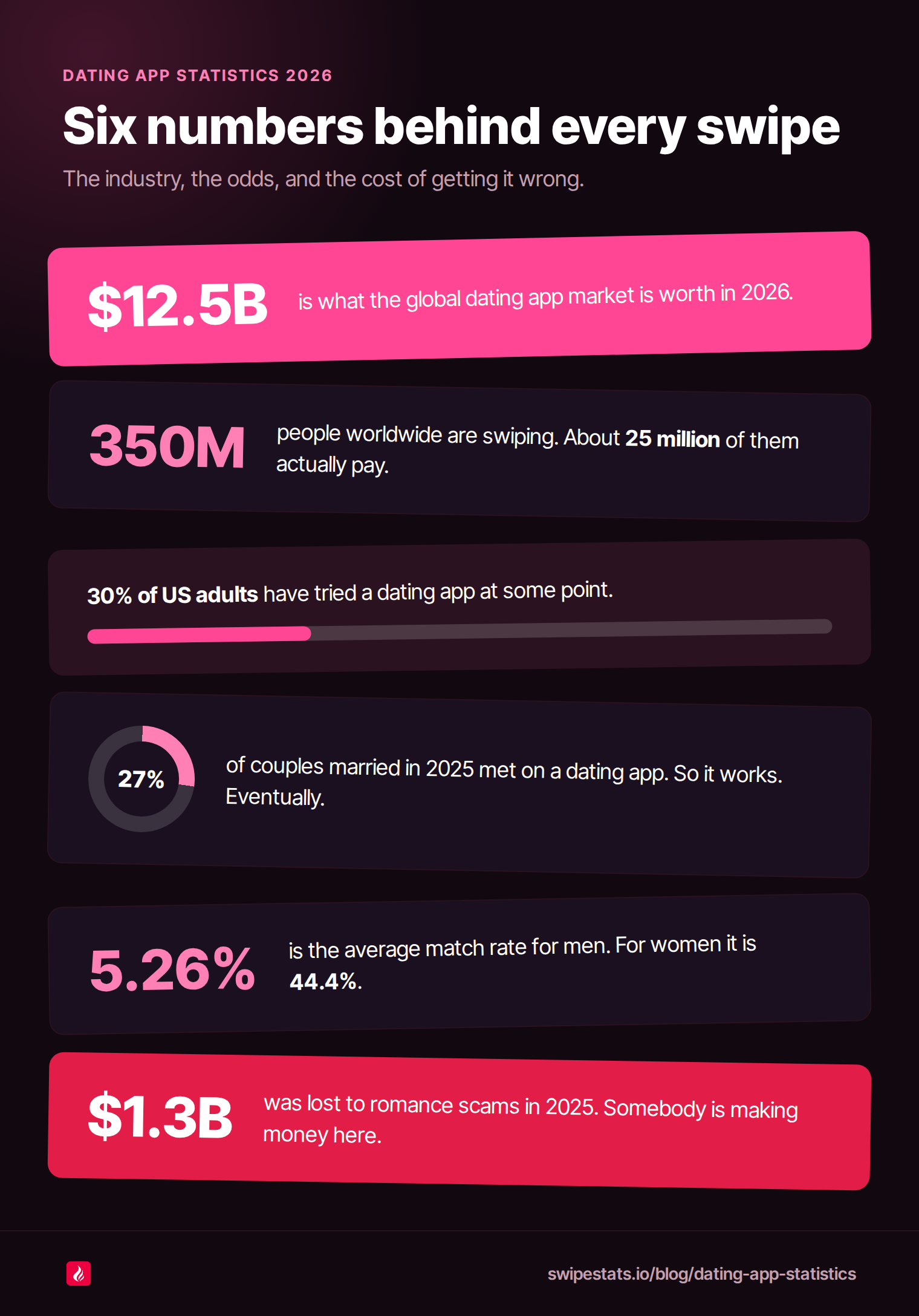
Six numbers, one screenshot. Save it for the next time someone tells you dating apps are a scam or a miracle.
The Dating App Numbers Nobody Wants to Hear
Let's start with the big picture dating app statistics, because context matters before we ruin your day with the personal stuff.
The global dating app market hit $12.5 billion in 2026. Over 350 million people worldwide are swiping, tapping, and sending desperate "hey" messages to strangers. About 25 million of those people actually pay for the privilege. The rest of us are out here grinding on free tier like it's a second job that doesn't pay.
In the US alone, 30% of adults have tried a dating app at some point (Pew Research). That's the most striking online dating statistic out there. Nearly one in three people admitting they've downloaded an app to find love, sex, or at minimum someone who'll laugh at their jokes. The other 70% are either lying or married.
Match Group, the company that owns Tinder, Hinge, and roughly half the apps on your phone, pulled in $3.47 billion in revenue in 2025. Tinder alone generated $463.8 million in Q4 2025. That's down 3% year-over-year, which sounds bad until you realize Tinder still has 75 million monthly active users and 9.8 million subscribers. The app is basically printing money while you're wondering why nobody swiped right on your gym selfie.
The real growth story is Hinge. The hinge statistics are wild: Q4 revenue hit $186 million, up 26% year-over-year. They've got 32 million users and 1.7 million paying subscribers. The "designed to be deleted" tagline is working. Or at least, people believe it is, which is honestly the same thing.
Then there's Bumble. Revenue down 7.4% year-over-year. Paying users dropped 16% to 3.6 million. The "women message first" gimmick is losing steam faster than your Tinder conversation after the third "haha yeah." Bumble's not dead, but it's on the treadmill and breathing heavy.
Who's Actually on These Apps (Spoiler: It's Mostly Dudes)
Here's where the dating app statistics get uncomfortable.
Our analysis of 7,000+ Tinder profiles shows a gender split of 67% male to 33% female. That means for every woman on Tinder, there are roughly two men competing for her attention. And "competing" is generous. Most of you are just flinging right swipes into the void like confetti at a parade nobody showed up to.
The gender ratio varies by app. Bumble is the closest to balanced at 54% male / 46% female. Hinge sits at 60% male / 40% female. Tinder is the sausage fest to end all sausage fests at 76% male / 24% female by some external estimates (our SwipeStats data shows 67/33 since women are less likely to upload their data. Either way, it's not great for the fellas).
Age-wise, 53% of 18-29 year olds have used a dating app. That drops to 37% for 30-49, 20% for 50-64, and just 13% for 65+ (Pew Research). So if you're a young man on Tinder, congratulations. You're in the most saturated, most competitive dating pool in human history. Your grandpa just had to show up to a dance and not step on anyone's feet.
Pew Research Center online dating hub.
This gender imbalance is the single most important dating app statistic in this entire article. Every other number you're about to read. The brutal match rates. The message gaps. The desperation swiping. It all traces back to this one ratio. Too many men, not enough women, and an algorithm that's more than happy to sell you a "boost" to fix a problem that's fundamentally about supply and demand.
Swipe Right, Get Ignored: The Match Rate Reality
Alright, let's talk about the number that keeps men up at night (besides their body count, which is probably lower than they claim).
SwipeStats data from 7,000+ Tinder profiles and 294 million swipes reveals the brutal truth about tinder statistics:
- Men's average match rate: 5.26% (median: 2.04%)
- Women's average match rate: 44.4% (median: 41.27%)
Read that again. For every 100 right swipes, the average guy gets about 5 matches. The average woman gets 44. Women are 8.4x more likely to match than men. If dating apps were a video game, men would be playing on Legendary difficulty while women are on Easy mode. (Before the comments section explodes: women have their own problems on these apps. Getting matches isn't the same as getting good matches. But the raw numbers don't lie.)
The swiping behavior tells the rest of the story. Men swipe right an average of 15,609 times (median: 5,096). Women swipe right 2,283 times (median: 989). Men are out here carpet-bombing with right swipes while women are using a sniper rifle.
And here's the kicker. Women pass on an average of 41,100 profiles. Men pass on 28,086. Women are seeing more profiles AND being pickier about them. Men are seeing fewer profiles and saying yes to nearly everything that has a pulse. This is the "spray and pray" strategy, and it backfires spectacularly. Tinder's algorithm actually punishes indiscriminate swiping by lowering your visibility. So every time you mindlessly swipe right on 500 profiles in a row, you're actively making your situation worse. Good job.
Want proof that desperation doesn't work? The top 1% of Super Like users sent an average of 3,248 Super Likes. Their match rate? 1.94%. That's actually LOWER than the overall average. You can't brute-force attraction, no matter how many little blue stars you throw at it.
The Message Gap Is Even Worse Than You Think
Matching is one thing. Actually talking to a human being is another.
Women receive an average of 2,727 messages on Tinder. Men receive 1,224. Women send 1,790 messages on average. Men send 1,474. So women are both receiving more messages AND sending more messages. The stereotype of guys never getting responses? The data backs it up.
Men open the app an average of 5,646 times. Women open it 3,779 times. Men are checking Tinder almost 50% more often than women. That's a lot of pulling down to refresh on a phone that isn't buzzing.
The effort-to-reward ratio for men on dating apps is genuinely brutal. More swipes, more app opens, more time invested, fewer matches, fewer messages. It's like applying for jobs on LinkedIn except the job is a dinner date and the rejection comes in the form of absolute silence.
If you're a guy reading this and feeling called out, here's the thing. The path to more matches isn't swiping harder. It's swiping smarter. Fix your photos. Write a bio that doesn't read like a hostage note. Be selective. The algorithm rewards quality engagement, not frantic desperation.
Dating App Statistics by Race and Demographics
This is the section everyone Googles and nobody wants to talk about at dinner parties.
OKCupid's famous (and now deleted) blog posts from their internal data showed clear racial biases in dating app behavior. Asian men and Black women received fewer messages on average. White men and Asian women received the most. These patterns have been replicated in academic studies since then. The apps didn't create these biases. They just made them measurable. And the measurements are ugly.
Height matters too. Research consistently shows that men under 5'9" get significantly fewer matches. One YouTube analysis of Tinder data found that listing a height of 6'0" or above correlated with noticeably higher match rates. Is that fair? No. Is it reality? Yes. Dating apps have turned the things people used to politely overlook into filterable deal-breakers.
Age preferences reveal another uncomfortable pattern. Men across all age groups consistently prefer women aged 20-22. A 35-year-old man's "ideal match" age and a 55-year-old man's "ideal match" age are basically the same. Women's age preferences tend to track much closer to their own age. Make of that what you will. (I know what I make of it, and it's not flattering to my gender.)
Income and occupation play a role too, though it's harder to quantify on swipe-based apps where you can't filter by salary. On platforms where income is visible, higher earners get more attention. Shocking revelation, I know. Next you'll tell me that people prefer attractive photos.
Do Dating Apps Actually Work? (Or Are We All Just Wasting Our Thumbs?)
Here's the part where I throw you a bone, because this article has been pretty bleak so far.
27% of couples who got married in 2025 met on a dating app (The Knot). Over 50% of engaged couples in 2025 met through apps. Let that sink in. More than half of people getting engaged right now found each other by swiping on their phones. Your parents met at a bar or through mutual friends. Your kids will probably meet through whatever holographic swiping app exists in 2045.
And the relationships seem to stick. A PubMed study found that the divorce rate for couples who met online was 5.96%, compared to 7.67% for couples who met offline. Online couples divorce LESS. Maybe because when you've already survived the hellscape of modern dating apps together, nothing else seems that bad by comparison.
42% of dating app users say apps made finding a partner easier. As for intentions, 44% are using apps to find a long-term partner, while 40% are there for casual dating. The remaining 16% presumably still haven't figured out what they want, which honestly tracks with my experience swiping through bios that say "just seeing what's out there" (translation: "I have commitment issues but still want attention").
So yes. Dating apps work. They're responsible for a massive and growing percentage of relationships. The question isn't whether they work. It's whether they work for YOU. And that depends a lot on your profile photos, your approach, and your willingness to not be another "hey what's up" guy in a sea of "hey what's up" guys.
The Billion-Dollar Scam Economy
While you're out there looking for love, someone else is looking for your wallet.
Romance scam losses exceeded $1.3 billion in 2025 according to the FTC. That makes romance scams one of the most profitable fraud categories in America. A McAfee report from 2026 found that 1 in 7 adults have lost money to a romance scam. One in seven. That's more common than left-handedness.
And it's getting worse. AI-generated photos and deepfake video calls mean scammers don't even need to steal someone else's pictures anymore. They can generate a completely fake person who looks exactly like your type. The catfish of 2020 was using stolen Instagram photos. The catfish of 2026 is using Midjourney.
Beyond scams, 48% of dating app users reported experiencing some form of unwanted behavior on the platforms (Pew Research). That includes unsolicited explicit messages, harassment, and continued contact after saying no. This is a bigger problem for women, which partly explains why the gender ratio is so skewed. When half your user base has a bad experience, they leave. And then the ratio gets worse. And then more women leave. It's a doom spiral, and the apps are only now starting to take it seriously.
Tinder vs Bumble vs Hinge: The Numbers Head-to-Head
Let's put these three side by side because I know you're wondering which app deserves your time (and potentially your money).
| Metric | Tinder | Bumble | Hinge |
|---|---|---|---|
| Monthly Active Users | 75M | 50M+ | 32M |
| Paying Users | 9.8M | 3.6M | 1.7M |
| Q4 2025 Revenue | $463.8M | ~$250M | $186M |
| Revenue Trend | Down 3% YoY | Down 7.4% YoY | Up 26% YoY |
| Gender Split (M/F) | 76/24 | 54/46 | 60/40 |
| Best For | Volume, global reach | More balanced gender ratio | Relationship-focused |
Tinder is the biggest, but it's shrinking. It's the McDonald's of dating apps. Everyone knows it, everyone's been there, and the quality is... fine. The sheer volume means you'll always have people to swipe on. But the gender ratio is punishing for men, and the app has become so associated with hookup culture that anyone looking for something serious often swipes with one foot out the door.
Bumble has the best gender ratio, which should be its superpower. But the "women message first" mechanic leads to a lot of matches that expire because she never sends that opening message. Revenue is declining. Paying users are fleeing. Bumble needs a reinvention, and the numbers reflect that urgency.
Hinge homepage.
Hinge is the growth story. Fastest revenue growth, most relationship-oriented user base, and a design that actually encourages conversation through prompts instead of just photos. The user base is smaller, but the intent is higher. If Tinder vs Bumble is Coke vs Pepsi, Hinge is the craft soda that everyone keeps recommending.
What These Dating App Statistics Actually Mean for You
Alright, you've made it through the data dump. Congratulations. You now know more about dating app statistics than 99% of the people swiping next to you on the subway. Let's turn that knowledge into something useful.
If you're a man: The math is against you. A 5.26% match rate means you need to be strategic, not desperate. Stop swiping right on every profile. Invest in better photos. Write a bio that shows personality instead of listing your height and saying "just ask." The guys who succeed on dating apps aren't the ones who swipe the most. They're the ones who give women a reason to swipe back.
If you're a woman: You have the statistical advantage in matching, but that comes with its own problems. Too many matches, too many bad openers, too many people who aren't actually looking for what you're looking for. Being selective isn't just a preference. It's a survival strategy.
For everyone: Upload your data to SwipeStats and see where you actually stand. Knowing your real match rate, your swipe patterns, and how you compare to others is the first step to fixing what's broken. You can't improve what you don't measure.
The dating apps aren't going anywhere. More than half of new couples are meeting on them. The question is whether you're going to be one of the success stories or one of the 97.37% of right swipes that go nowhere. Your call.
Sources
- Pew Research Center: Key Findings About Online Dating in the U.S.
- Grand View Research: Dating Services Market Size 2026
- Match Group Q4 2025 Earnings Report
- Bumble Inc. 2025 Annual Report
- The Knot 2025 Jewelry and Engagement Study
- FTC Explore Data: Romance Scam and Fraud Reports
- McAfee 2026 Romance Scam Report
- PubMed: Online Dating and Divorce Rates
- SwipeStats Analysis: 7,000+ Tinder Profiles, 294 Million Swipes
About the Author

Also from Kristian: Homi is Kristian's AI workspace for organizing home searches with your partner, family, or agent.