Dating App Statistics by Gender: What 294 Million Swipes Tell Us About Men vs Women
The numbers don't lie. They just hurt.
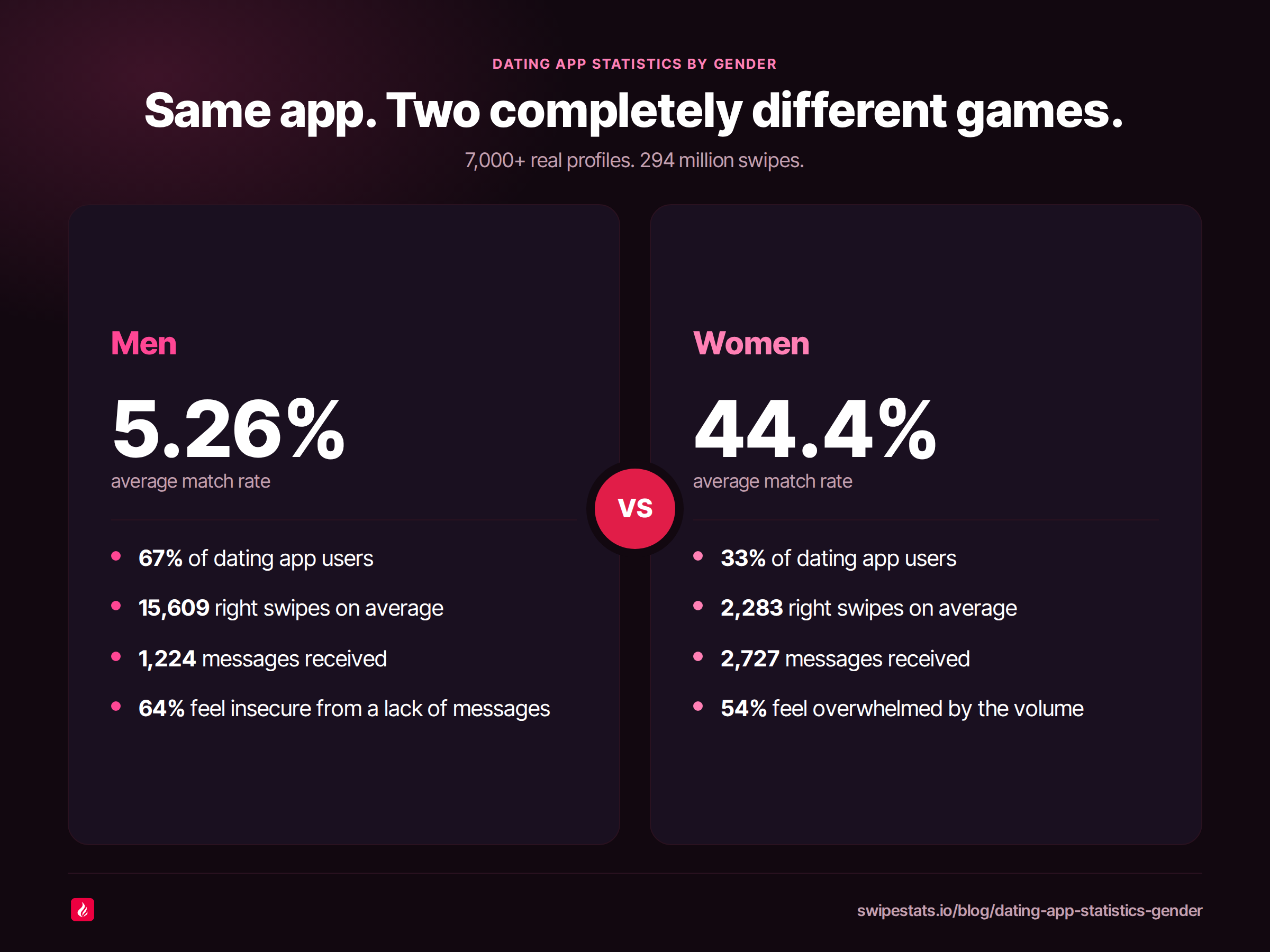
- 67% of dating app users are men, 33% are women. You're not imagining the competition. It's literally 2-to-1.
- Men swipe right 15,609 times on average while women swipe right just 2,283 times. One gender is carpet-bombing. The other is using a sniper rifle.
- Women's average match rate on Tinder is 44.4%. Men's is 5.26%. That's not a gap. That's a canyon you could park the Grand Canyon inside of.
- Women send more messages than men (1,790 vs 1,474 on average) but receive twice as many (2,727 vs 1,224). The messaging experience is two completely different apps.
- 54% of women feel overwhelmed by the volume of messages they get. 64% of men feel insecure from a lack of them. Same app. Parallel universes.
Dating App Statistics by Gender: The Great Divide Nobody Wants to Admit
Let me save you some suspense. If you're a man on a dating app, the game is rigged against you. If you're a woman, the game is rigged against you too, just in completely different ways. Everyone loses. Congratulations.
I'm Paw, and at SwipeStats we've analyzed data from over 7,000 real dating app profiles and 294 million swipes. Not surveys where people lie about their behavior. Not "estimated" data from some marketing firm. Actual, cold, brutal numbers pulled directly from user data exports.
And those numbers paint a picture that should make every dating app CEO squirm in their Herman Miller chair.
The Dating App Gender Ratio: A 2-to-1 Sausage Fest
Let's start with the elephant in the room (or rather, the 67 elephants).
According to our data and corroborated by a 2023 survey of over 60,000 people in the US, 67% of online dating service users are men, while only 33% are women. That's a 2:1 ratio before a single swipe happens.
Here's what the dating app gender ratio looks like across the major platforms:
| Dating App | Male Users | Female Users |
|---|---|---|
| Tinder | 75-78% | 22-25% |
| Hinge | 60% | 40% |
| Bumble | 61% | 39% |
| OkCupid | 65% | 35% |
Tinder is basically a boys' locker room with a few women who wandered in by accident. Hinge has the best balance, but even there, men outnumber women 3-to-2. Bumble's "women make the first move" gimmick attracts slightly more women, but "slightly" is doing heavy lifting in that sentence.
To put this in terms your brain can actually process: imagine a room with 100 dating app users. 67 of them are men. 33 are women. Even if every single woman matched with one man, 34 guys would walk out empty-handed. And that's the best-case scenario. The math gets uglier from there.
Pew Research found that 34% of men have used dating apps compared to 27% of women. Men are not only more numerous on the apps, they're more likely to try them in the first place. Desperation? Optimism? The human capacity for suffering? Pick your favorite explanation.
Tinder Gender Ratio: Where the Imbalance Hits Hardest
The Tinder gender ratio deserves its own section because it's where the disparity reaches almost comic proportions. At roughly 75% male to 25% female, every woman on Tinder has three men competing for her attention.
But the ratio is only half the story. Let's talk about what men and women actually DO on the app.
Swiping: The Shotgun vs. The Sniper
Our SwipeStats data from 7,000+ profiles reveals:
- Men swipe right 15,609 times on average (median: 5,096)
- Women swipe right 2,283 times on average (median: 989)
Men are swiping right on everything that moves. Women are curating like they're selecting art for the Louvre.
On the flip side:
- Women swipe left 41,100 times on average (median: 19,553)
- Men swipe left 28,086 times on average (median: 10,051)
Women see more profiles AND reject more of them. External research backs this up: women pass on roughly 95% of profiles they see, while men pass on about 47%. So if you're a guy wondering why your match rate is abysmal, understand that the average woman is saying no to 19 out of every 20 men she sees. Your competition isn't just other men. It's the sheer mathematics of selectivity.
Match Rates: The Number That Breaks Men's Spirits
Here's the stat that makes grown men weep into their pillow:
- Women's average match rate: 44.4% (median: 41.27%)
- Men's average match rate: 5.26% (median: 2.04%)
Women are 8.4 times more likely to match than men. For every 100 right swipes, a woman gets about 44 matches. A man gets about 5.
Let me translate that into human pain: the average man needs to swipe right on ~19 profiles to get one match. The average woman needs about 2. That's not a level playing field. That's one person playing on flat ground and the other person scaling Everest in flip-flops.
The Hinge Gender Ratio: Slightly Less Brutal
Hinge sits at about 60% male to 40% female, making it the closest thing to a balanced dating app ecosystem we've got. That "designed to be deleted" tagline apparently attracts a slightly more even crowd.
The better ratio means men on Hinge have a noticeably different experience than on Tinder. When your competition drops from 3-to-1 to 3-to-2, you can feel it. It's like going from a packed Black Friday sale to a busy Tuesday at Target. Still crowded. But you can breathe.
Bumble Gender Ratio: The Women-First Myth
The bumble gender ratio of 61% male to 39% female is nearly identical to Hinge, despite Bumble's entire brand being built around "women make the first move." You'd think that design choice would attract more women. It does. Just barely.
What Bumble does accomplish is a different kind of dynamic. Our Bumble statistics show that women have a 45% match success rate on the platform while men sit at about 3%. The women-first model doesn't fix the ratio problem. It just means women control the conversation initiation, which honestly just shifts where the bottleneck sits.
How Men and Women Use Dating Apps Differently (The Behavioral Gap)
The dating app gender gap goes way deeper than who swipes right more. The entire experience is fundamentally different depending on your gender.
App Usage: Men Are Addicted, Women Are... Also Addicted (But Less So)
Our SwipeStats data shows:
- Men open the app 5,646 times on average (median: 2,224)
- Women open the app 3,779 times on average (median: 1,931)
Men check dating apps like they're monitoring a stock portfolio during a market crash. The medians are closer together (2,224 vs 1,931), which means most people use the app a similar amount. But there's a subset of men who are opening Tinder with the frequency of someone checking whether the oven is still on.
Fun seasonal twist: male usage spikes significantly during May through July. Summer horniness is apparently a measurable phenomenon. Women's usage stays relatively flat year-round. Make of that what you will.
Messaging: Two Completely Different Inboxes
Contrary to what you might expect (given men's reputation for being communicative Neanderthals), our data shows women actually send more messages:
- Women send 1,790 messages on average (median: 760)
- Men send 1,474 messages on average (median: 371)
But the inbox situation? Wildly different:
- Women receive 2,727 messages on average (median: 1,372)
- Men receive 1,224 messages on average (median: 321)
Women receive more than double the messages men do. The median tells an even bleaker story: 1,372 messages for women vs. 321 for men. That's the difference between "I can't keep up with all these conversations" and "has anyone messaged me this week?" (Narrator: they had not.)
This is backed by Pew Research's finding that 54% of women feel overwhelmed by the volume of messages they receive on dating apps. Meanwhile, 64% of men feel insecure because of the lack of messages they get. Same app. Two radically different emotional realities.
Why Men Swipe Right on Everyone (And Why It Makes Everything Worse)
Here's where it gets genuinely interesting from a game theory perspective.
Men have adopted a volume strategy: swipe right on everyone, filter later. When your match rate is under 3%, casting a wide net feels rational. Why be picky when 97 out of 100 swipes lead nowhere anyway?
But this creates a vicious cycle. When men swipe right on everyone, the algorithm interprets mass-right-swiping as low-quality behavior and depresses your visibility. The Tinder algorithm literally punishes you for being desperate. And when women receive a flood of matches from men who swiped indiscriminately, many of those matches are from guys who don't actually want to talk. So women's match quality goes down even as their match quantity stays high.
Everybody's rational behavior creates a collectively irrational outcome. The men who carpet-bomb actually get worse results than they would with selective swiping. The women who match easily can't tell who's genuinely interested. It's a prisoner's dilemma where everyone is the prisoner.
Do Super Likes Fix the Gender Gap? (Spoiler: No)
Dating apps love selling you the illusion of a shortcut. Super Likes are the most popular one. Our data says they're largely a scam:
- Men use 93.7 Super Likes on average (median: 1)
- Women use 4.8 Super Likes on average (median: 0)
Most women don't use Super Likes at all. Most men don't either (the median is 1), but a small group goes absolutely nuclear with them. The top 1% of Super Like users sent 3,248 Super Likes and had a match rate of just 1.94%. That's actually WORSE than the average man's overall match rate of 5.26%.
Let that sink in. The people spending the most on Super Likes are getting worse results than the average free user. If that's not a damning indictment of paid dating app features, I don't know what is.
What Men vs Women Actually Want (The Motivation Gap)
It's not just behavior that differs. The reasons men and women show up on dating apps are fundamentally different.
Pew Research found that among current dating app users, 31% of men cited casual sex as a major reason for using the platform compared to just 13% of women. When it comes to looking for a long-term partner (44%) or casual dating (40%), the gender differences disappear.
So the narrative that "men just want hookups" is partly true, partly lazy. A solid chunk of men on dating apps want exactly what women want: something real. They're just fighting through a 2-to-1 ratio and a 3% match rate to find it.
The experience gap creates a perception gap, which creates a behavior gap, which widens the experience gap. Women have so many options that they become more selective. Men have so few that they become less selective. And dating apps profit from both sides of the frustration. (Funny how that works.)
What Dating App Statistics by Gender Mean for YOUR Profile
Enough doom and gloom. Here's what the data actually suggests you should do:
If you're a man:
- Stop swiping right on everyone. The algorithm punishes it, and a 5.26% match rate means you need quality, not volume.
- Invest in your photos. When women are rejecting 95% of profiles, your photos need to be in the top 5% to get noticed. That's not optional.
- Understand what gets matches. The data shows that profile completeness and selective swiping actually improve your algorithm score.
- Skip the Super Likes. Our data shows they have a lower match rate than regular right swipes for power users.
If you're a woman:
- Know that the ratio is in your favor mathematically but against you experientially. More matches does not equal better matches.
- Be aware that a significant portion of your matches swiped right on everyone. Not every match is a genuine expression of interest.
- Use apps with better gender ratios if quality matters more than quantity. Hinge and Bumble offer a slightly less lopsided experience.
If you're frustrated regardless of gender:
- Upload your data to SwipeStats and see where you actually stand. Knowing your match rate percentile is the first step to improving it, or at least understanding that the system is working as designed and that "as designed" just sucks.
The Uncomfortable Truth About Dating App Gender Statistics
Here's what the dating industry doesn't want you to hear. Dating apps don't benefit from fixing the gender imbalance. They profit from it.
When men feel starved for matches, they pay for boosts. When women feel overwhelmed, they pay for filters. The frustration is the product. The match is just the carrot they dangle to keep you swiping.
Our dataset of 7,000+ profiles and 294 million swipes confirms what anyone who's spent time on these apps already suspects: men and women are having completely different experiences on the same platform. And both experiences, in their own way, are pretty terrible.
The gender gap on dating apps isn't a bug. It's a feature. A very profitable one.
Sources
- Pew Research Center: Key Findings About Online Dating in the U.S.
- Pew Research Center: Online Dating Among Lesbian, Gay and Bisexual Americans
- Jimenez-Muro et al. (2024): Dating App Users: Differences Between Middle-Aged Men and Women
- SwipeStats Proprietary Dataset: 7,000+ Tinder Profile Uploads, 294M Swipes
About the Author

Also from Kristian: Homi is Kristian's AI workspace for organizing home searches with your partner, family, or agent.