Hinge vs Bumble vs Tinder: The Only Dating App Comparison That Isn't Total BS
Features, dating intent, and a Tinder benchmark to help you choose.
TL;DR: The Honest Verdict
So you want to know which dating app to use. Hinge vs Bumble vs Tinder. The eternal question asked by every single person staring at their phone at 11pm wondering why they're alone. I got you.
- Hinge wins for serious relationships. Best free tier, best match quality, and 87% of users actually want something real. Also uses a Nobel Prize-winning algorithm, which is more than you can say about your approach to dating.
- Bumble is the middle child. Women message first, which is great in theory and exhausting in practice. Paying users dropped 16% in Q3 2025. Ouch.
- Tinder is the Walmart of dating apps. Biggest user base (75M monthly users), most casual, cheapest entry price. Best for hookups and people who enjoy having their self-esteem destroyed efficiently.
- The harsh truth: In our volunteered Tinder sample, men averaged 5.3% matches per right swipe, with a 2.04% median. Those figures do not measure Hinge or Bumble.
- We analyzed 7,000+ real profiles with 294 million right swipes and 3.14 million matches at SwipeStats. This isn't vibes. This is math.
Our 7,079-profile, 294-million-right-swipe benchmark covers Tinder uploads. It does not measure Hinge or Bumble performance; comparisons here also use product features and separately attributed sources.
Why Every Other Dating App Comparison Is Garbage
Let's address the elephant in the room. You've probably already read five other articles comparing these apps. They were all trash.
Most dating app comparison articles are thinly disguised affiliate roundups written by someone who downloaded all three apps for a weekend, swiped 30 times, and called it "research." They hit you with the same recycled bullet points about "user-friendly interfaces" and "diverse user bases" and then slap an affiliate link at the bottom. Groundbreaking journalism.
Here's what makes this different. At SwipeStats, we've analyzed 7,000+ voluntarily uploaded Tinder profiles containing 294 million right swipes and 3.14 million matches. That's not "I tried Bumble for a month and here's what happened." That's actual behavioral data from thousands of real humans desperately trying to find love (or at least someone to watch Netflix with).
I'm Paw Markus. I've been running SwipeStats for years, I've personally used all three of these apps extensively, and I've seen the data on what actually works. So when I tell you which app is better, it's not because some brand deal is paying me to say it. It's because the numbers don't lie. Even when they're brutal. Especially when they're brutal.
Hinge vs Bumble vs Tinder: The Numbers Will Roast You
Before we get into the weeds, here's the big picture. If you just want the difference between Tinder, Bumble and Hinge in one screen, this is it. Side by side. No fluff.
| Feature | Tinder | Bumble | Hinge |
|---|---|---|---|
| Monthly Active Users | ~75M | ~50M | ~30M |
| Paying Subscribers | 9.8M | 3.6M (down 16%) | 1.53M |
| Gender Split | 75% male | 64% male | 60% male |
| Male Match Rate (SwipeStats sample) | Mean 5.3%; median 2.04% | Not measured in this sample | Not measured in this sample |
| Best For | Casual dating, hookups | Women wanting inbox control | Serious relationships |
| Free Likes Per Day | Limited (~100) | ~100 swipes | 8 likes |
| See Who Liked You (Free) | No | No | Yes (one at a time) |
| Revenue (Annual) | $1.8B+ | ~$800M | $550M |
| Cheapest Premium | ~$10/mo | ~$15/mo | ~$30/mo |
A few things jump out immediately. Tinder is 75% male. That means for every woman on the app, there are three dudes competing for her attention. That's not a dating pool. That's a sausage fest with a search function.
Hinge has the most balanced gender split at 60/40. Still not great, but compared to Tinder's ratio, it looks like a feminist utopia.
And Bumble? Their paying users dropped 16% in a single quarter. The company is literally rebuilding their platform from scratch. Make of that what you will.
Match Rates: Where Your Swipes Go to Die
This is where things get painful. Grab a drink. You'll need it.
Our SwipeStats data from thousands of real profiles shows that the average male right-swipe rate is 53%. That means the average dude swipes right on more than half the profiles he sees. You'd think with that kind of enthusiasm, matches would be flowing. You'd be wrong.
In our volunteered Tinder sample, men's mean match rate was 5.3% and the median was 2.04%. The median matters: a few high-performing profiles can pull the average up. Women averaged 44.4% matches per right swipe in the same sample.
These uploads are self-selected. They describe the people who shared data with SwipeStats, and they cannot tell you what your personal result will be on another app.
- Tinder: The sample gives you a benchmark to compare with your own export.
- Bumble: Opening Moves and the conversation timer change how a match becomes a conversation. We do not have a comparable Bumble match-rate estimate here.
- Hinge: Likes can include comments on a photo or prompt, giving you something to talk about from the start. Its smaller free allowance encourages selectivity.
78% of Gen Z daters report dating app burnout, according to a Forbes Health survey. No kidding. Swiping through hundreds of profiles while getting almost no results back is basically a part-time job that pays in disappointment.
The silver lining? Hinge's limited likes system actually helps. When you can only like 8 profiles a day, you stop mindlessly right-swiping everything with a pulse and start actually reading profiles. Revolutionary concept, I know.
How Each App Actually Works (For Normal Humans)
Tinder: The Walmart of Dating Apps
Let's not pretend Tinder is something it's not. It's the biggest, the loudest, and the most shameless dating app on the planet. And honestly? It knows exactly what it is.
75 million monthly active users. That's more people than the entire population of the UK. Tinder works everywhere. Small town in Iowa? Tinder's there. Backpacking through Southeast Asia? Tinder's there. Sitting on the toilet at 2am? Tinder is absolutely there.
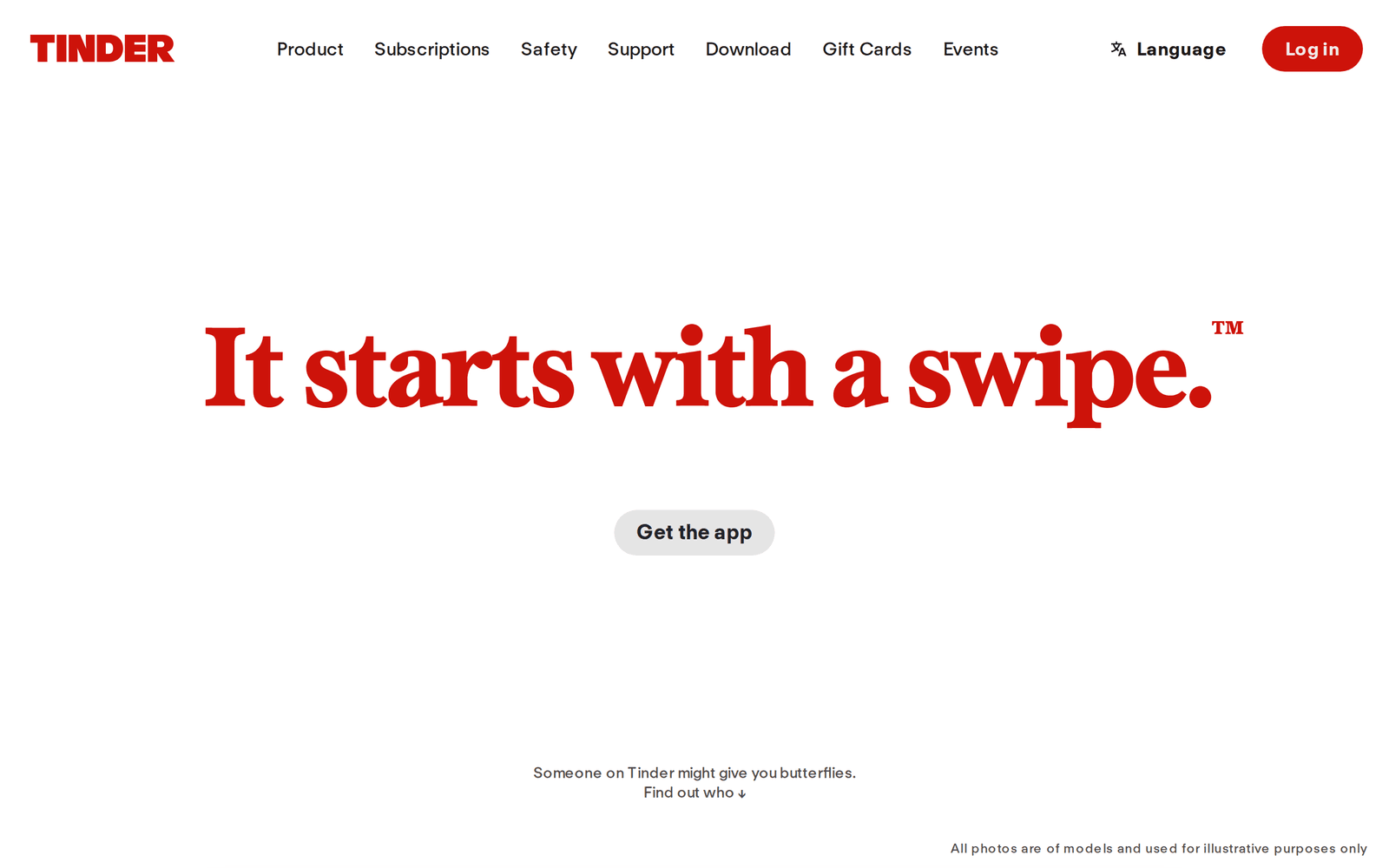
Tinder homepage. Fourteen years in and the pitch is still one verb.
The core experience hasn't changed much since 2012. See face. Swipe right or left. If mutual, you match. Then one of you says "hey" and the conversation dies three messages later. The circle of life.
What's new in 2026:
- Modes feature: You can now set your profile to "serious" or "casual" so people know what you're after. About time.
- Chemistry AI matching: Tinder is investing $60 million in AI to improve their matching. Whether this means better matches or just fancier ways to show you people out of your league remains to be seen.
- FaceCheck safety verification: Reduces catfishing. A feature that probably should have existed a decade ago.
The Tinder algorithm rewards selective swiping and punishes mass right-swipers. If you're swiping right on literally everyone, the algorithm tanks your visibility. It's Tinder's way of saying "we see what you're doing and we don't respect it."
Free users get limited swipes per day. Premium features like seeing who liked you, Passport (change location), and unlimited swipes require Tinder Plus, Gold, or Platinum. Our full Tinder review breaks down whether Tinder Gold is worth it.
Bottom line: on Hinge vs Tinder specifically, Hinge wins on intent and Tinder wins on sheer numbers. Tinder is best for casual dating, hookups, and people who want maximum volume. If you're looking for a serious relationship, you CAN find one here, but you'll be wading through a lot of "just here for a good time" profiles first.
Bumble: Ladies First (Whether You Like It Or Not)
Bumble's whole thing is that women message first. In heterosexual matches, the guy can't say a word until she initiates. She has 72 hours to message or the match disappears forever.
Sounds empowering. And for many women, it is. No more inbox full of unsolicited "hey sexy" messages from dudes who clearly didn't read a single word of your profile. That's genuinely nice.
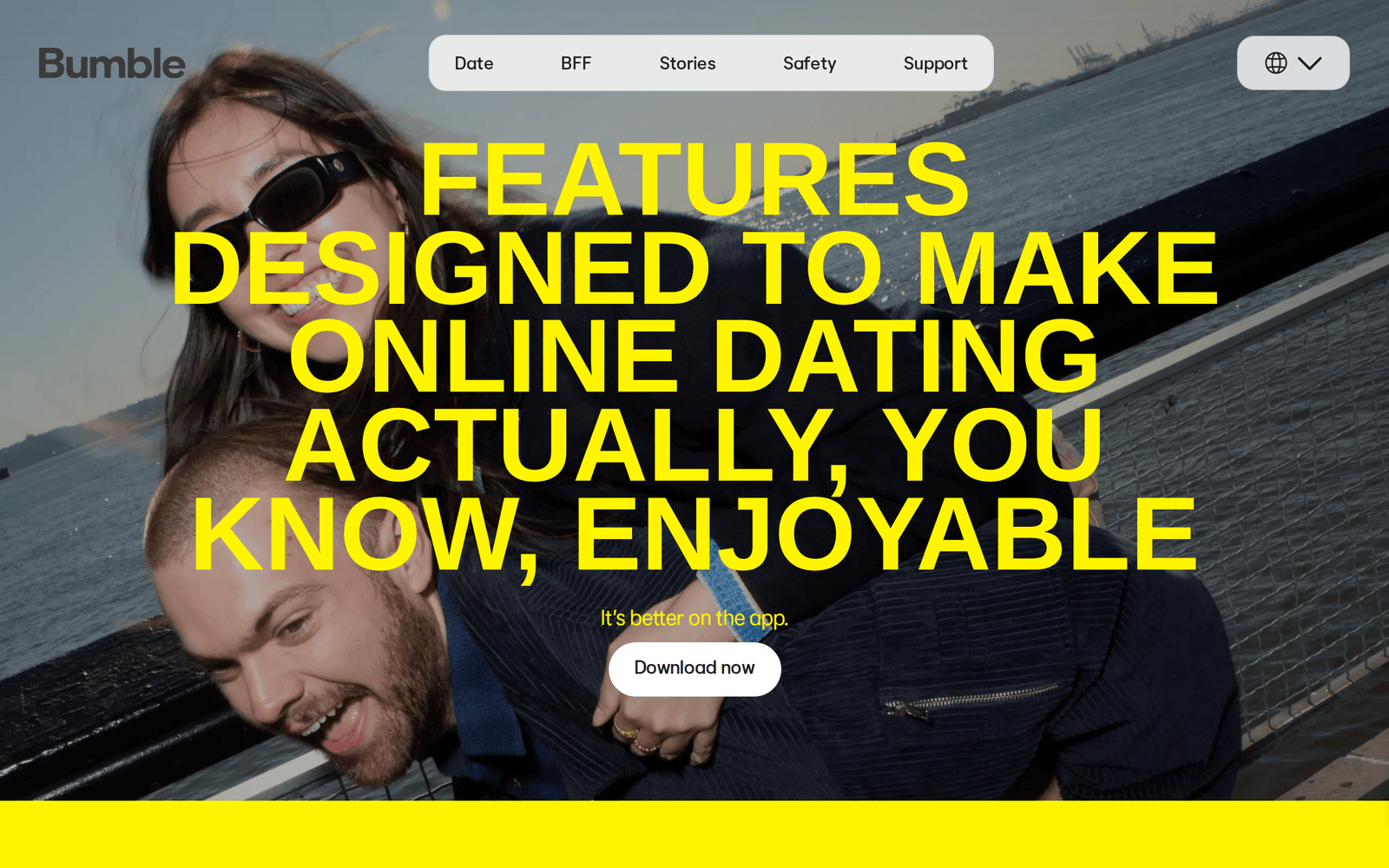
Bumble features page. Note how hard it works to sell the experience rather than the size of the pool.
But here's what nobody talks about: a lot of women find the "always message first" thing exhausting. Multiple studies and countless Reddit threads confirm that women often feel pressured by the expectation. Some literally write "you message first" in their Bumble bios. On the app where that's impossible. The irony is thick enough to spread on toast.
For men? It's a waiting game. You swipe, you match, and then you sit there like a golden retriever staring at the door waiting for its owner to come home. If she doesn't message in 72 hours, poof. Gone. All that careful swiping for nothing.
Bumble does offer some workarounds. Opening Moves lets men suggest conversation starters that women can choose from. Speed Dating mode allows messages before matching. But the core experience is still women-first.
Beyond dating, Bumble has BFF mode (for making friends) and Bizz mode (for professional networking). Genuinely useful if you've just moved to a new city. Less useful if you downloaded a dating app to, you know, date.
The concerning numbers: Bumble's paying users dropped 16% in Q3 2025. The company announced it's rebuilding its platform from scratch. That's corporate speak for "things aren't going great and we need to figure our shit out."
Bottom line: Bumble is best for women who want inbox control and people who like the urgency of a 72-hour timer. For guys, it's an exercise in patience and hoping someone finds you interesting enough to type a first message. So is Bumble better than Hinge? For most men, no. For women who want to control who talks to them first, it genuinely can be.
Hinge: "Designed to Be Deleted" (LOL Sure)
Hinge calls itself "the dating app designed to be deleted." Bold marketing for a company whose revenue grew from $8 million to $550 million in six years. If everyone actually deleted the app, they'd be out of business by Thursday. But I digress.
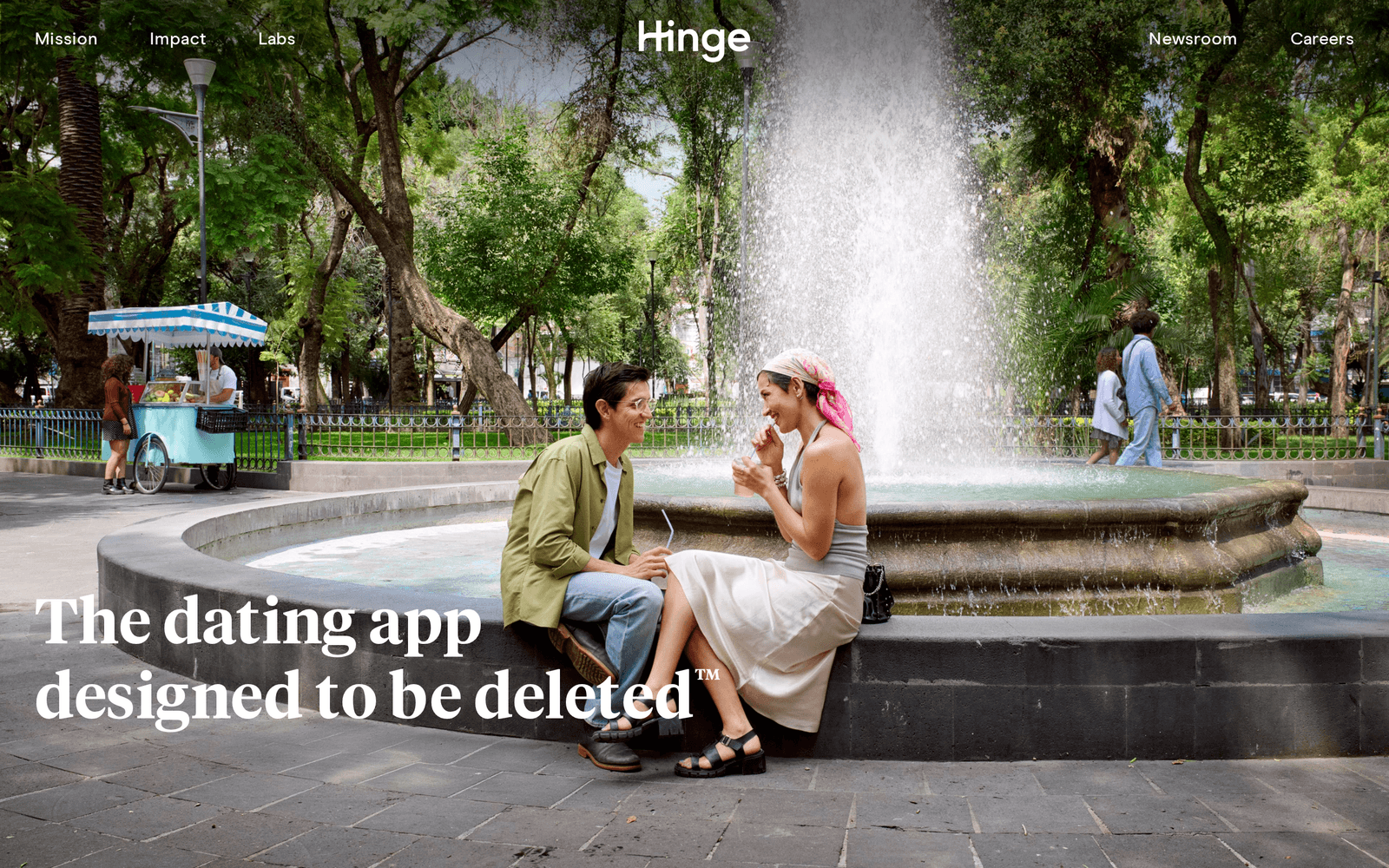
Hinge homepage. The tagline is right there, unbothered by its own contradiction.
What makes Hinge different is the comment-on-profile model. Instead of mindless swiping, you scroll through someone's full profile (6 photos + 3 prompt answers) and like a specific photo or prompt with a comment attached. "Your dog in that third photo looks like he's judging everyone at the park" is infinitely better than "hey."
The algorithm runs on a Nobel Prize-winning Gale-Shapley stable matching system. Yes, the matching algorithm behind Hinge is based on math that literally won a Nobel Prize. Your dating app is smarter than you. Let that sink in.
Free users get 8 likes per day. That sounds limiting (because it is), but it forces you to actually read profiles instead of spam-swiping like a caffeinated robot. And here's the kicker: free users can see who liked them. One at a time, but still. Tinder and Bumble charge premium for that.
New features in 2025-2026 include AI Convo Starters (the app suggests opening messages) and Prompt Feedback (AI tells you if your prompts suck). It's like having a brutally honest friend who lives inside your phone.
The user base is where Hinge really shines. 87% of Hinge users report looking for serious relationships. Compare that to Tinder where half the profiles say "just here for a good time" and the other half say "not here for hookups" but their photos suggest otherwise.
The proof is in the pudding: 35% of married couples who met on apps used Hinge. That's more than Tinder (25%) and Bumble (20%) combined... well, not combined, but you get the point. Hinge also boasts a 72% second-date rate, which means most first dates from the app don't end in mutual ghosting. Progress.
Bottom line: Hinge is best for people who actually want a relationship and are willing to put in the effort of writing thoughtful comments instead of just swiping. If you think 8 likes a day sounds limiting, you might be part of the problem.
The Price of Desperation: What Each App Costs in 2026
Dating apps have figured out the ultimate business model: charge lonely people money for a slightly better chance at human connection. Capitalism at its finest.
| Tier | Tinder | Bumble | Hinge |
|---|---|---|---|
| Free | Limited swipes, ads, basic features | ~100 swipes, 1 advanced filter, no Beeline | 8 likes, see likes (one at a time), free location change |
| Entry Premium | Plus: ~$10/mo | Boost: ~$15/mo | Hinge+: ~$30/mo |
| Mid Premium | Gold: ~$15/mo | Premium: ~$30-55/mo | -- |
| Top Premium | Platinum: ~$20/mo | Premium Plus: ~$100/mo | HingeX: ~$50/mo |
Let's be real about what you actually get for free on each app:
Tinder Free is like the demo version of a video game. You can play, but you're constantly reminded that the full experience costs money. Limited swipes, no seeing who liked you, ads everywhere. It works, but barely.
Bumble Free gives you ~100 swipes per day (way more volume), but you can't see who liked you, can't change your location, and only get one advanced filter. The free experience feels designed to frustrate you into paying.
Hinge Free is honestly the best free dating app experience of the three. Eight likes per day sounds stingy until you realize you can see who liked you, change your location, and use dealbreaker filters. All free. All features Bumble and Tinder charge for.
The verdict on pricing: Tinder is the cheapest entry point. Bumble is the most expensive at the top tier (a hundred bucks a month for Premium Plus? Come on). And Hinge has the best free experience, which means you might not need to pay at all.
My honest take after years of seeing the data: premium subscriptions help if your profile is already good. If your profile sucks, paying for more visibility just means more people see your bad photos faster. Fix the foundation first. Then consider paying.
Which App Is Best For You? (The Honest Answer)
If You Want Something Serious
Hinge. Not even close.
35% of married couples who met through dating apps used Hinge. The 72% second-date rate suggests people are actually connecting, not just collecting matches like Pokemon cards they never use.
Everything about Hinge pushes you toward real conversation. The prompt system gives you something to talk about. The limited likes stop you from treating dating like a video game. The algorithm is literally based on Nobel Prize-winning mathematics designed to create stable matches.
Bumble and Tinder CAN lead to serious relationships. People meet their spouses on both platforms. But that's like saying you CAN win the lottery. Technically true, statistically unlikely compared to the alternative.
If You Just Want to Hook Up
Tinder. It knows what it is.
Largest user pool means more options. The most casual user base means less pretending. Tinder pioneered the "swipe for hookups" model and, despite years of trying to rebrand as a relationship app, that's still what most people use it for.
Just be upfront about it. Nobody likes the person who says "looking for something serious" on Tinder and then ghosts after the first date. We all know what you're doing. Stop.
If You're a Guy
Buckle up, because the numbers are grim everywhere.
For quality: Hinge. The 60/40 gender split is the best you're going to get. Three dudes per woman on Tinder versus roughly 1.5 on Hinge. That's a massive difference in competition. Plus, you can message first with a comment, which means you're not sitting around praying she talks to you (looking at you, Bumble).
For volume: Tinder. More women overall, even if the ratio is worse. Sometimes you need to cast a wide net, especially if you're in a smaller market.
For neither: Bumble. Sorry, but the data isn't kind. You can't message first, matches expire if she doesn't initiate, and your match rate is roughly the same as Tinder but with added frustration. The best dating apps for men are the ones that let you take action.
If You're a Woman
You're in a much better position on all three apps (congrats on winning the dating app gender lottery), but there are still real differences.
For inbox control: Bumble. No more wading through mountains of "hey" and unsolicited weirdness. You decide who gets to talk to you. That's genuinely valuable.
For match quality: Hinge. The prompt-based profiles give you way more information to work with than Tinder's "three blurry photos and a bio that says 'just ask.'" The user base skews more relationship-minded, so less time filtering out people who aren't serious.
For options: Tinder. Biggest user base means the most variety. Check out our guide to the best dating apps for women for a deeper breakdown.
The Verdict: Which App Would I Pick?
Based on their features and the dating experience each aims to offer, here's where things land when you have to pick just one: Tinder, Bumble, or Hinge.
1. Hinge (Best Overall)
Hinge wins because it actually does what a dating app should do: facilitate real connections between real humans.
The limited likes force intentionality. The prompt system creates conversation hooks. The free tier is genuinely functional. The user base overwhelmingly wants relationships. The algorithm is based on actual science, not just "you both swiped right, good luck."
Is it perfect? No. Eight likes a day can feel painful. Premium is expensive. It's only available in about 20 countries. But for pure dating effectiveness, nothing beats it in 2026.
2. Bumble (The Complicated Middle Child)
Bumble is a good app that's going through an identity crisis. The women-first messaging model is genuinely innovative. BFF mode is useful. The brand is strong.
But the declining subscriber numbers tell a story. The experience is frustrating for men. Premium is overpriced for what you get. And the company's decision to rebuild from scratch suggests even they know something needs to change.
If you're a woman who values inbox control, Bumble is excellent. For everyone else, it's fine. Not great. Fine.
3. Tinder (The Volume Play)
Tinder is still the biggest. Still the most recognizable. Still the default dating app for millions of people. And still probably not where you'll find your future spouse (but hey, 25% of married app couples say otherwise).
It's investing heavily in AI with that $60M commitment. The new Modes feature that separates serious and casual users is a step in the right direction. The user base is unmatched in size.
But the 75/25 gender ratio is brutal for men. The free tier is the most limited. And the app's reputation as a hookup platform means people looking for relationships often skip it entirely.
Use Tinder for what it's good at: volume, casual dating, and swiping while you're bored on the bus. For everything else, there are better options.
FAQ
Sources
- SwipeStats proprietary data: 7,000+ profiles, 294M right swipes, 3.14M matches
- Tinder Statistics 2026 - SwipeStats
- Bumble Statistics 2026 - SwipeStats
- Hinge Statistics 2026 - SwipeStats
- Dating App Statistics 2026 - SwipeStats
- Forbes Health: Dating App Burnout Survey - 78% of Gen Z report burnout
- Bumble Q3 2025 Earnings - 16% decline in paying users
- Match Group Earnings Reports - Tinder and Hinge financials
- Hinge Mission and Approach - Nobel Prize-winning matching system
- Business of Apps: Dating App Revenue Data
About the Author

Also from Kristian: Homi is Kristian's AI workspace for organizing home searches with your partner, family, or agent.