OkCupid Statistics: 50 Million Users and One Very Depressing Attractiveness Study
Everything the data says about OkCupid, from user numbers to the 80/20 rule that broke the internet
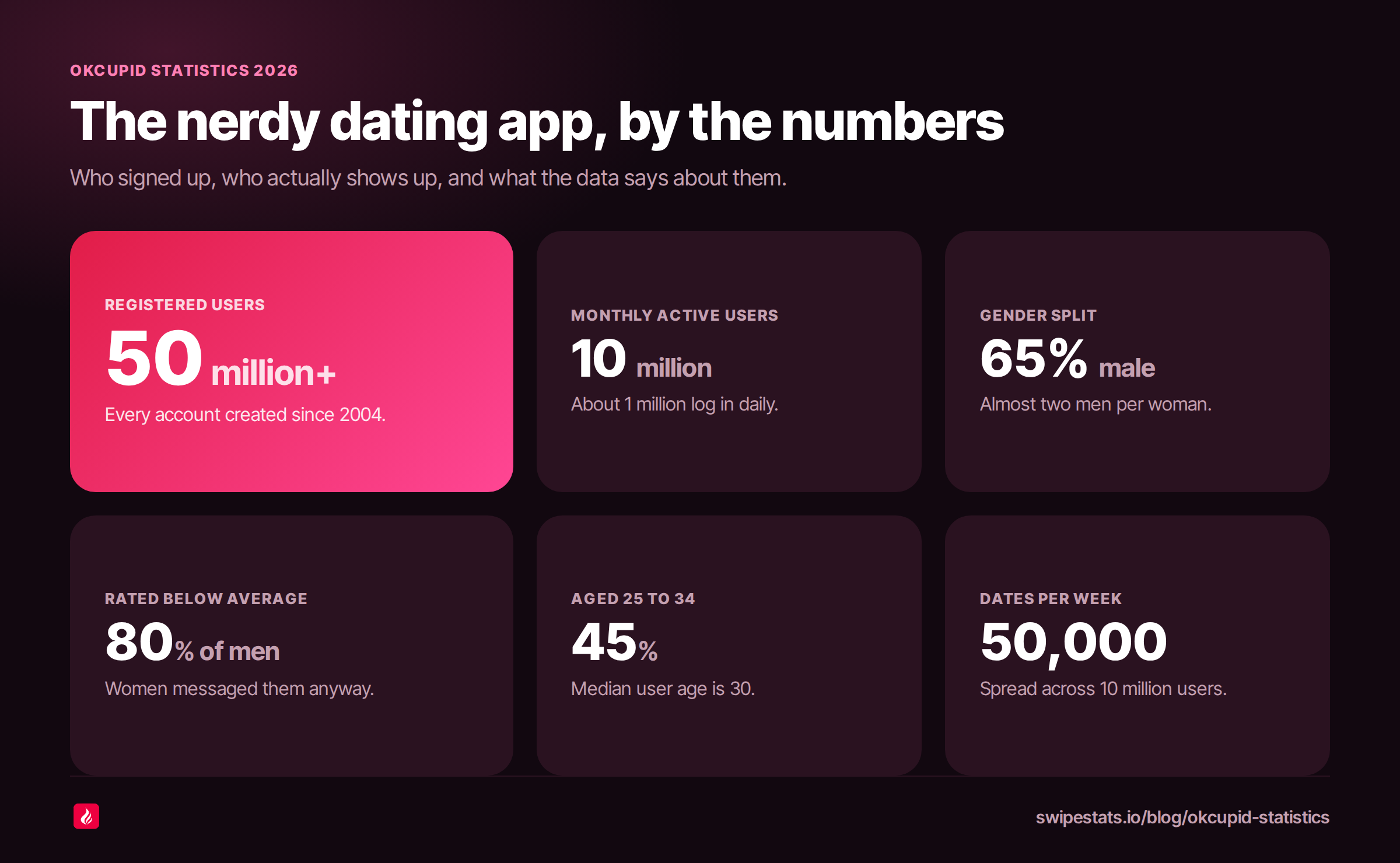
- OkCupid has over 50 million registered users worldwide, with roughly 10 million monthly active users and 1 million daily logins.
- The gender split is approximately 65% male, 35% female, which means dudes outnumber women almost 2:1. Sound familiar?
- OkCupid's infamous attractiveness study found that women rate 80% of men as below average looking. But before you spiral, women still messaged those "ugly" guys at reasonable rates.
- The most active age group is 25-34 year olds (about 45% of users), with a median user age of 30.
- OkCupid claims a 30% success rate for long-term relationships and says it's responsible for over 5 million marriages. Take that with a boulder of salt.
OkCupid Statistics: The Numbers Behind the Nerdy Dating App
OkCupid has been around since 2004, which in dating app years makes it roughly 400 years old. It was the dating app for people who thought they were too smart for the bar scene and too broke for Match.com. And honestly? The data OkCupid published over the years is some of the most fascinating (and brutal) research on human dating behavior ever collected.
I'm talking about the app that literally published blog posts telling you that women think 80% of men are unattractive. The same app that showed racial preferences in messaging patterns. The same app that ran experiments on its own users and then wrote about it like a proud scientist who just dissected a frog.
Let's dig into the OkCupid statistics that actually matter, from user counts to the studies that keep getting cited a decade later.
How Many People Use OkCupid in 2026?
OkCupid has over 50 million registered users globally, with around 10 million monthly active users. Roughly 1 million people log in daily.
Now, before you get too excited about that 50 million number, remember: "registered users" includes every account ever created since 2004. Your uncle who signed up in 2009, swiped three times, and went back to being lonely? He's in that count. The person who created an account to stalk their ex? Also counted.
The monthly active users number of 10 million is more telling. For context, Tinder has somewhere around 75 million monthly active users. Bumble pulls about 40 million. So OkCupid is playing third fiddle at best. It's like being the third most popular restaurant in a strip mall. You're technically still in business, but nobody's bragging about eating there.
| Metric | Number |
|---|---|
| Total registered users | 50+ million |
| Monthly active users | ~10 million |
| Daily logins | ~1 million |
| Matches facilitated yearly | ~91 million |
| Total matches since 2004 | 2+ billion |
| Daily swipes | ~10 million |
OkCupid also claims it facilitates around 50,000 dates per week. Which sounds impressive until you divide 50,000 by 10 million active users and realize your personal odds are, let's say, modest.
OkCupid Demographics: Who's Actually On This Thing?
Gender Breakdown (Spoiler: Sausage Party)
The gender ratio on OkCupid sits at roughly 65% male, 35% female. If you're a guy, that means you're competing with almost two other dudes for every woman on the platform. And some of those dudes are taller, funnier, and have better jawlines than you. Sorry.
OkCupid does deserve credit for one thing: the platform offers 22 gender options and 13 orientation options, making it one of the most inclusive dating apps out there. So while the binary male-to-female ratio skews male, the full picture is more nuanced than most competitors.
Age Demographics
The 25-34 age group dominates OkCupid, making up about 45% of all users. The median age is 30 for straight users, 27 for bisexual users, and 30 for gay users.
Here's the age breakdown:
| Age Group | Share of Users |
|---|---|
| 18-24 | ~20% |
| 25-34 | ~45% |
| 35-44 | ~20% |
| 45-54 | ~10% |
| 55+ | ~5% |
If you're over 40 on OkCupid, you're essentially the cool uncle at a college party. You can stay, but nobody's thrilled about it. Check out our Match.com review if you want an app where people your age actually hang out.
The Famous OkCupid Attractiveness Study (The 80/20 Rule)
This is the big one. The OkCupid study that launched a thousand Reddit arguments and gave incels a talking point they'd never shut up about.
Back in 2009, OkCupid's data team published a blog post called "Your Looks and Your Inbox." The key finding? Women rated 80% of men as "below average" in attractiveness. The distribution curve for how women rated men's looks was wildly skewed left, meaning most guys got rated as ugly by most women.
Men, on the other hand, rated women's attractiveness on a near-perfect bell curve. Which means guys collectively agreed that average-looking women are, well, average. Groundbreaking stuff from the male brain there.
But Here's What Everyone Ignores
The part of the OkCupid data that manosphere bros conveniently leave out: women still messaged guys they rated as unattractive at decent rates. Women's messaging behavior tracked much more closely with men's attractiveness bell curve than with their own brutal rating curve.
In other words: women thought 80% of guys were ugly, but they messaged them anyway. Men thought women's attractiveness followed a perfect bell curve, but they overwhelmingly messaged only the hottest women.
So who's actually being more shallow? The OkCupid statistics suggest it's not the gender you'd expect. Women said "you're ugly" and then sent a message. Men said "you're average" and then only talked to the top 20%.
If you're curious how your own match patterns compare across dating apps, upload your data and we'll show you exactly where you stand.
OkCupid Race and Messaging Data
OkCupid also published some of the most uncomfortable (and important) data on racial preferences in online dating. Their studies from 2009 to 2014 tracked response rates by race, and the findings were... not great for anyone's faith in humanity.
Key findings from the OkCupid stats on race:
- White men and women received the most messages and highest response rates across the board.
- Black women received the lowest response rates to their messages.
- Asian men received some of the lowest response rates from women of other racial groups.
- Racial preferences in messaging were consistent across multiple years of data.
OkCupid updated this data several times. In 2014, they noted that racial bias in messaging had decreased slightly over the years, but it was still very much present. The OkCupid study on race essentially confirmed what many people already knew: dating apps amplify existing societal biases.
The original blog posts have since been deleted from OkCupid's website (convenient, right?), but the data lives on in Christian Rudder's book "Dataclysm" and across approximately 47 million Reddit threads.
OkCupid Age Preferences: Men Are Predictable, Women Are Not
OkCupid's data on age preferences produced one of the most widely shared statistics in online dating history.
What Men Want (It's Embarrassing)
According to OkCupid data, men of all ages rate 20-year-old women as the most attractive. A 25-year-old man? Thinks 20-year-olds are the hottest. A 35-year-old man? Also thinks 20-year-olds are the hottest. A 50-year-old man? You guessed it. Still thinks 20-year-olds are peak attractiveness.
The four most attractive ages for women, according to men across every age bracket: 20, 21, 22, and 23. That's it. That's the whole finding. Men are remarkably consistent in the one thing nobody asked them to be consistent about.
What Women Want (It's Reasonable)
Women, by contrast, preferred men roughly their own age or slightly older. A 20-year-old woman preferred 23-year-old men. A 30-year-old woman preferred men around 30-32. A 40-year-old woman preferred men around 38-42.
In other words, women's age preferences tracked closely with reality. Men's age preferences tracked closely with Leonardo DiCaprio's dating history.
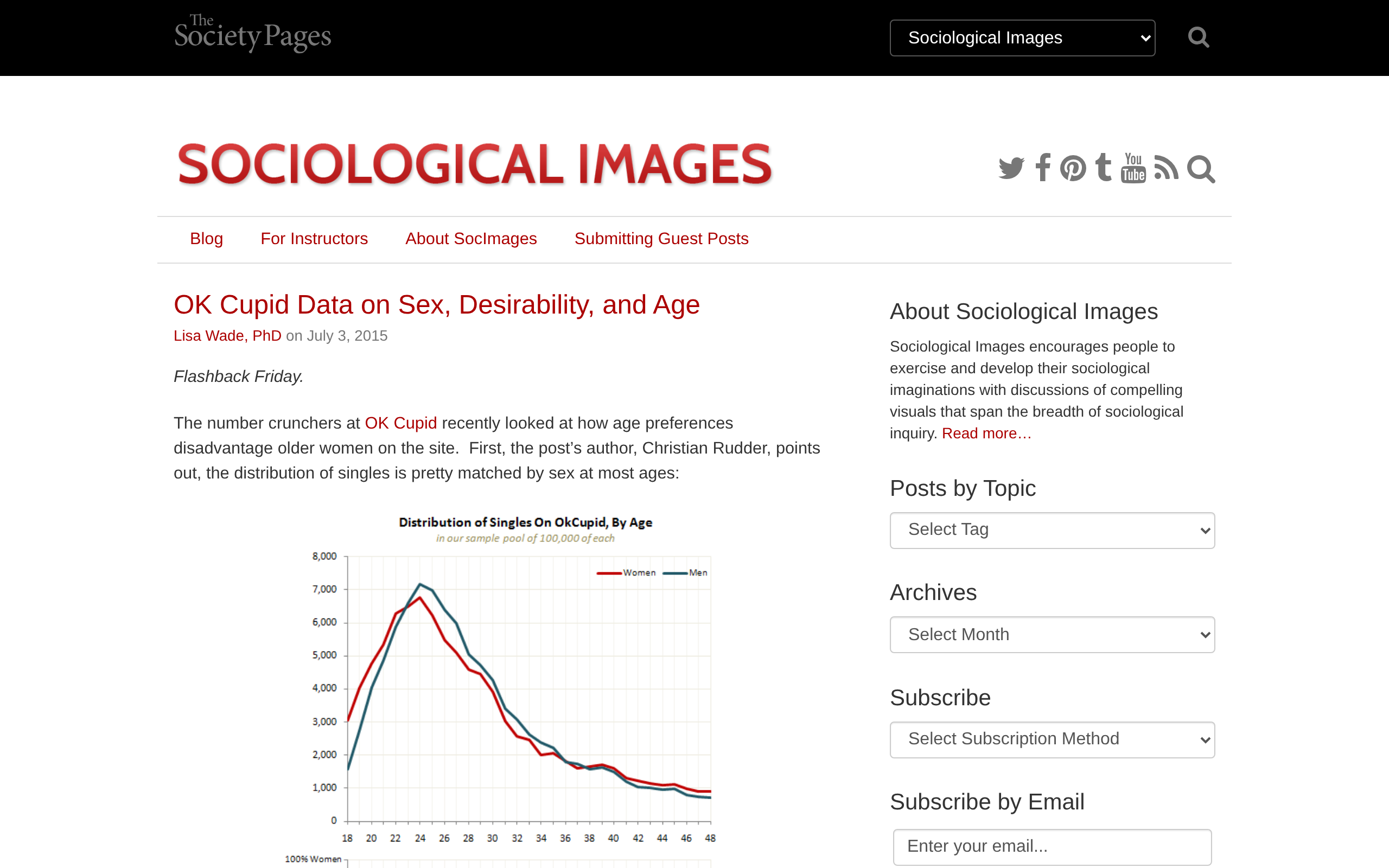
But here's the saving grace: OkCupid also showed that men's actual messaging behavior was much more age-appropriate than their stated preferences. Guys might rate 20-year-olds highest, but they mostly messaged women within a few years of their own age. So there's some hope for humanity. A sliver.
OkCupid Revenue and Business Statistics
OkCupid is owned by Match Group (the company behind Tinder, Hinge, Match.com, and roughly half the dating apps on Earth). Here's the business side of things:
| Metric | Value |
|---|---|
| Parent company | Match Group |
| Q1 2023 revenue | ~$30 million |
| Paying subscribers | ~5 million |
| Founded | 2004 |
| Acquired by Match Group | 2011 (~$50 million) |
| Matching questions answered | 500+ million |
| Countries available | 110+ |
Match Group bought OkCupid in 2011 for around $50 million. For context, Match Group later acquired Hinge for $295 million. Even in corporate acquisitions, OkCupid can't catch a break.
The platform makes money through OkCupid Premium and OkCupid Basic subscriptions, plus various boost features. Premium costs roughly $35-45/month depending on your plan length, which is steep for an app where 65% of users are dudes competing for the same 35% of women. Our OkCupid review breaks down what you actually get for the money.
OkCupid Match and Success Rate Statistics
OkCupid claims a 30% success rate for users finding long-term relationships. They also say they've been responsible for over 5 million marriages worldwide since launching.
I have some questions about how "success rate" is defined here (did they count everyone who went on a date? everyone who stayed together more than 3 months? everyone who didn't immediately unmatch?), but the number's out there.
More granular OkCupid stats on matching:
- 91 million connections per year
- 50,000 dates per week
- Users who answer the matching questions about current events get a 30% higher match rate
- Users open to dating sober individuals receive 12% more Likes and 29% more Matches
- 93% of users report being completely honest on their profiles (sure, and I'm 6'2")
- Over 500 million matching questions have been answered since 2004
The matching question system is actually OkCupid's secret weapon. Unlike Tinder, which matches you based on looks and location, OkCupid uses those hundreds of questions to calculate a compatibility percentage. Answer enough questions, and the algorithm theoretically gets smarter about who it shows you.
Theoretically.
OkCupid User Behavior Statistics
OkCupid's data blog (RIP, sort of) published some wild findings about how people actually use the platform:
Messaging Patterns
- The first message length that gets the best response rate is 40-90 characters. Not a novel. Not "hey." Something in between.
- Messages that mention specific interests from someone's profile have a higher response rate than generic openers. Shocking revelation, I know.
- People who use correct grammar and spelling in messages get significantly more responses. So maybe proofread that "hay ur cute" before hitting send.
Profile Behavior
- 93% of users claim to be honest on their profiles. The other 7% are at least honest about lying.
- Men on OkCupid overstate their height by an average of 2 inches. Which tracks with every first date I've ever been on where the "6-foot" guy is somehow at my eye level (I'm 5'10").
- Photos with animals get more engagement. But you already knew that. Borrow a golden retriever if you have to.
The Experiments
OkCupid famously admitted to running experiments on users. In 2014, they revealed they had:
- Told some users they were compatible when they weren't (and vice versa)
- Removed profile photos to see if people would judge based on personality alone (they did, briefly, then left when the photos came back)
- Manipulated match percentages to study how suggestion affects behavior
Their defense? "Guess what, everybody: if you use the Internet, you're the subject of hundreds of experiments at any given time, on every site. That's how websites work." Bold stance from a company playing God with people's love lives.
How OkCupid Compares to Other Dating Apps
Here's how OkCupid stacks up against the competition:
| Stat | OkCupid | Tinder | Bumble | Hinge |
|---|---|---|---|---|
| Monthly active users | ~10M | ~75M | ~40M | ~23M |
| Gender ratio (M:F) | 65:35 | 75:25 | 57:43 | 64:36 |
| Primary age group | 25-34 | 18-34 | 22-35 | 25-35 |
| Matching system | Questions + algorithm | Swipe | Swipe + women first | Prompts + likes |
| Free messaging | Yes (limited) | Matches only | Matches only | Matches only |
OkCupid's biggest advantage is its free messaging (though they've limited it heavily over the years) and the compatibility question system. Its biggest disadvantage is that it's the dating app equivalent of a Blockbuster Video. Everyone knows what it is, fewer and fewer people actually use it, and younger users can't understand why it still exists.
If you want to see how your Tinder stats compare, or you're curious about Bumble's numbers, we've got deep dives on those too. There's also a head-to-head Bumble vs OkCupid breakdown if you're deciding between the two.
OkCupid's Decline: What the Numbers Tell Us
Let's be real: OkCupid's best days are behind it. Web traffic data shows that okcupid.com gets about 6.2 million monthly visits, which sounds decent until you remember it used to be THE online dating destination.
Several factors contributed to the decline:
- Match Group acquisition in 2011 led to gradual "Tinder-fication" of the platform (adding swiping, limiting free messaging)
- Deletion of the iconic data blog in 2020 removed one of OkCupid's most compelling differentiators
- Competition from Hinge stole the "relationship-focused app" positioning
- Younger users defaulting to Tinder and Bumble for the simpler swipe experience
The irony is thick: OkCupid was the original data-driven dating app, the one that proved dating could be analyzed and optimized with statistics. And then it got bought by the company that made swiping on faces the industry standard.
What OkCupid Data Tells Us About Dating in General
Forget OkCupid the app for a second. The OkCupid studies changed how we think about online dating. Here's what their data confirmed:
- Attractiveness standards differ wildly by gender. Women are harsher raters but more egalitarian messagers. Men are generous raters but ruthlessly selective messagers.
- Racial bias exists in dating. It's measurable, consistent, and deeply uncomfortable to look at.
- Age preferences reveal gender asymmetry. Men's taste stays frozen at "20-year-old" regardless of their own age. Women's taste matures with them.
- People lie about height. The average self-reported height on OkCupid was 2 inches above the national average. Statistically impossible unless dating apps attract unusually tall people (they don't).
- Compatibility algorithms work. Sort of. OkCupid's own experiments showed that telling people they were compatible made them behave as if they were. The power of suggestion is stronger than the power of actual compatibility.
If any of these findings make you want to analyze your own dating data, we built a tool for exactly that. SwipeStats shows you your match rates, messaging patterns, and how you compare to other users across 7,000+ real Tinder profiles.
FAQ
Sources
- Your Looks and Your Inbox (OkTrends, archived)
- Race and Attraction, 2009-2014 (OkTrends, archived)
- OkCupid research archive (Gwern)
- OK Cupid Data on Sex, Desirability, and Age (The Society Pages)
- OkCupid Profiles Dataset (Kaggle)
- OkCupid Study Reveals the Perils of Big-Data Science (Wired)
- SwipeStats: Dating App Statistics
About the Author

Also from Kristian: Homi is Kristian's AI workspace for organizing home searches with your partner, family, or agent.