Photogenic Meaning: What It Actually Means (And Why Your Dating Profile Depends on It)
The science behind why some people look amazing in photos and others look like a police lineup
TL;DR. You're Not Ugly, You Just Can't Take Photos
Look. The reason you hate every photo of yourself isn't because you got hit with the ugly stick. It's because you don't know how cameras work. Welcome to your wake-up call.
- Photogenic means you photograph well. It's a skill. You can learn it. Stop using "I'm just not photogenic" as an excuse.
- Science explains why you look weird in photos: lens distortion warps your face by 30%, and the mere exposure effect means your mirror image feels "right" while photos feel wrong.
- Dating app photos drive 52% of swipe decisions. Profiles with high-quality photos get a 34% match rate vs 5% for bad ones. That's a 7x difference. Your blurry bathroom selfie is statistically ruining your love life.
- Fix it: chase good lighting, learn your angles, take 60 shots and keep 1, and for the love of god, back away from the selfie camera.
- Being photogenic won't save a trash profile, but being unphotogenic will absolutely sink a good one.
The photo-performance figures cited below come from a commercial provider’s report. They are associations in that provider’s analysis, and do not establish what changing your photos will cause.
What Does Photogenic Actually Mean? (Spoiler: It's Not Genetics)
Let's start with the photogenic meaning, since that's probably why you Googled your way here. Merriam-Webster defines it as "suitable for being photographed especially because of visual appeal." That's the photogenic definition in its simplest form. The word itself comes from Greek. "Photos" meaning light, "genic" meaning producing. You are literally "produced by light." Poetic, right?
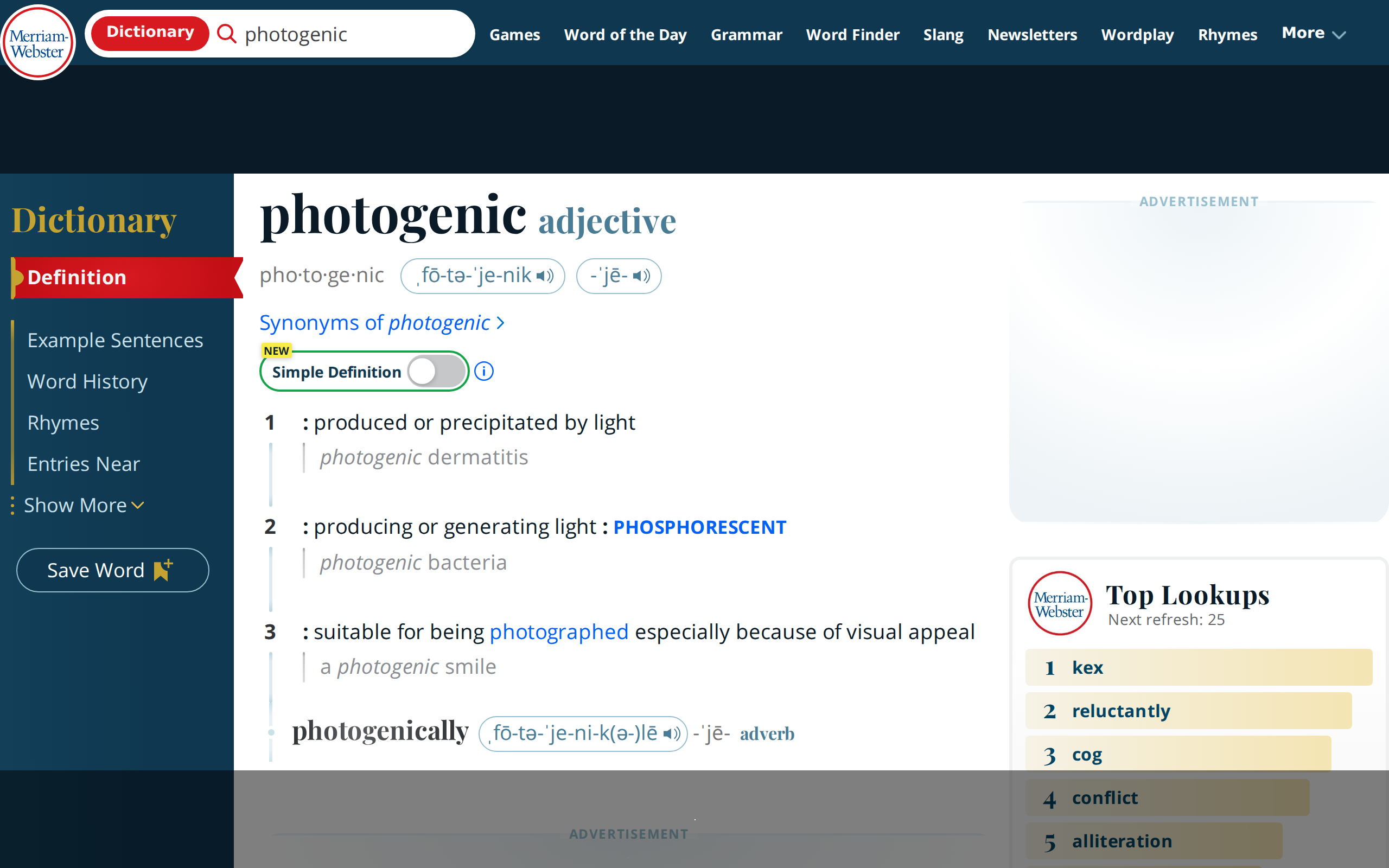
Worth noting: the dictionary meaning of photogenic is older and broader than the one you care about. The first two senses are about light itself, "produced or precipitated by light" and "producing or generating light." The third sense is the one that decides your match rate.
Here's the part that matters: being photogenic has almost nothing to do with being attractive. You can be absolutely stunning in person and look like a haunted wax figure in every photo. And the reverse is true too. Some people who are average in real life photograph like they were sculpted by Renaissance angels with Photoshop licenses.
What does photogenic mean in practice? It means you know how to work with a camera. That's it. Every photographer, every YouTuber, every researcher who's studied this agrees. Being photogenic is a practiced skill, not something coded into your DNA. So if you've been telling yourself "I'm just not photogenic" as a permanent identity, congratulations, you've been lying to yourself. Stop that.
Why You Look Like a Different Person in Photos (Blame Science, Not Your Face)
Here's something that blew my mind when I first dug into this. There are at least three separate scientific reasons why you look different (read: worse) in photos than in the mirror. And none of them have anything to do with your actual face.
The Mere Exposure Effect. Psychologist Robert Zajonc demonstrated in 1968 that people prefer things they've seen before. You've stared at your mirror image thousands of times. That's the version of your face your brain has decided is "you." But mirrors flip your image. Photos don't. So every photo shows you the reversed version of the face you're used to. It looks subtly wrong, and your brain screams "that's not me" even though everyone else thinks it looks completely normal. You're not ugly. You're just unfamiliar with your own unflipped face.
Lens distortion is screwing you over. Your smartphone's selfie camera uses a wide-angle lens (roughly 24mm) that distorts facial proportions by nearly 30%. Your nose looks bigger. Your forehead expands. Your ears seem to shrink. It's not your face. It's physics doing you dirty. And it gets worse the closer you hold the camera. Those arm's-length selfies you've been taking? They're basically funhouse mirror portraits.
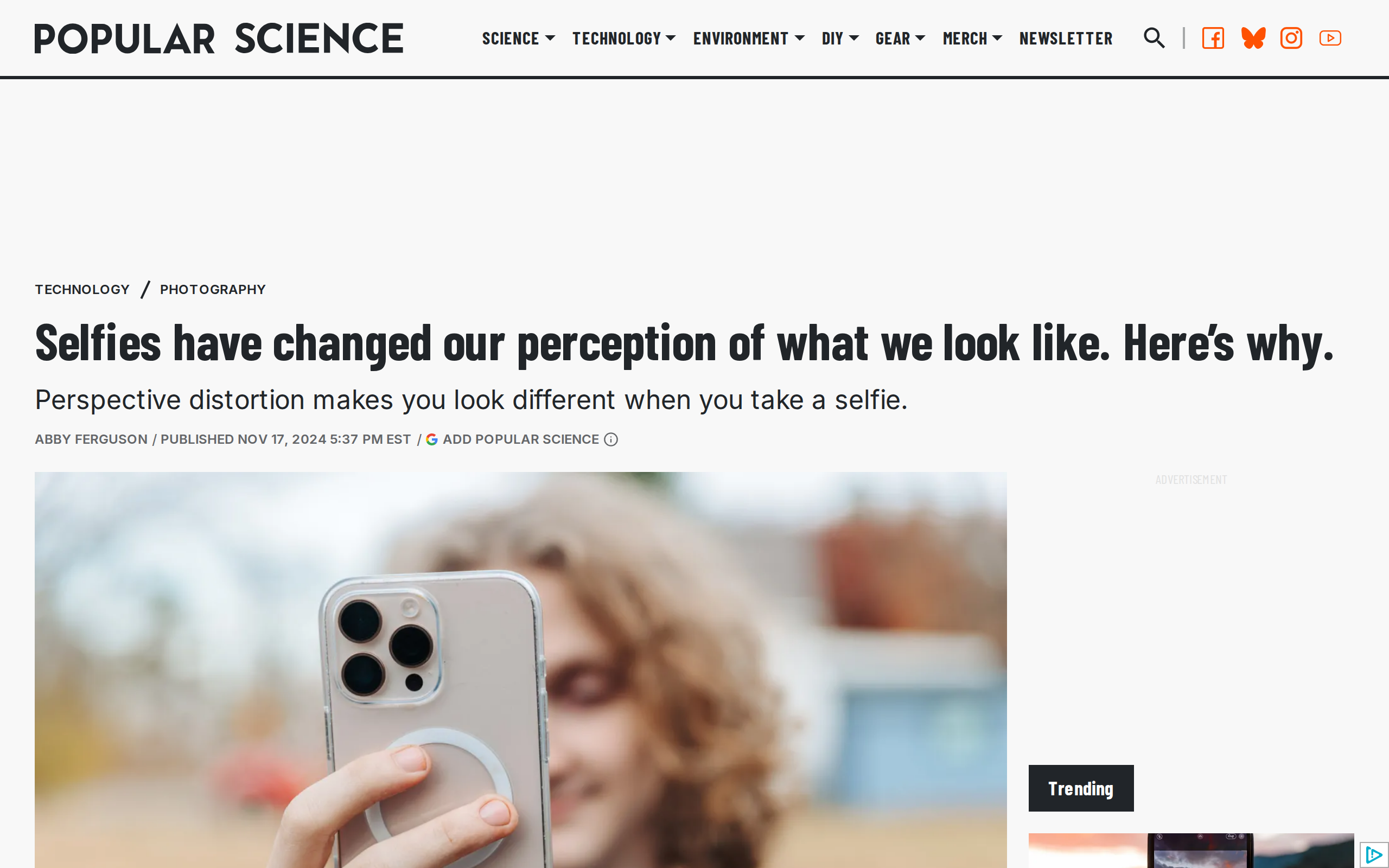
This isn't just vanity talking. 72% of facial plastic surgeons reported patients wanting procedures specifically to look better in selfies, up from 42% in 2015. Doctors literally coined the term "Snapchat Dysmorphia" because people were bringing in filtered selfie photos as their surgical goals. Let that sink in. People are getting surgery to match a lens-distorted, filtered version of themselves that never existed.
You think you're hotter than you are. Epley and Whitchurch found in 2008 that 65% of people select a version of their face that's been digitally enhanced by at least 10% as their "real" photo. Your brain has been running a secret Photoshop operation on your self-image for years. So when you see an unedited photo, the gap between your internal self-image and reality feels jarring. It's not that the photo is bad. It's that your mental selfie was too good.
The left-side bias. Blackburn and Schirillo demonstrated in 2012 that your left cheek is consistently rated as more pleasant and appealing. The right hemisphere of your brain (which controls the left side of your face) handles emotional expression. Your left side literally shows more emotion, warmth, and personality. Portrait painters have known this for centuries. Now you know it too.
Is "You're So Photogenic" Actually a Compliment? (Depends Who's Saying It)
Someone tells you "you're so photogenic" and you smile. But should you?
On the surface, sure. "You look great in photos!" That's a nice thing to say. But dig one layer deeper and some people hear the subtext: "You look BETTER in photos than in person." Which is basically a dressed-up version of "the camera is doing a lot of heavy lifting here, buddy."
Whether it's a compliment depends entirely on context. If someone sees you in person and says it after seeing your dating profile, they might be politely noting that your profile photos promised Chris Hemsworth and delivered Chris from accounting. If someone who knows you well says it while looking through your vacation photos, they're just being nice.
The real compliment you want? "You look even better in person." That's the goal. Your photos should be you on your best day, not you in an alternate dimension where you have different bone structure.
Why Being Photogenic Is a Superpower on Dating Apps
Alright, here's where things get real. And by real, I mean depressing for anyone who's been phoning it in with their photos.
AURA, a commercial profile-photo service, reports that its study analyzed 1.8 million dating profiles and found that 52% of swipe decisions are based on the first photo alone. The average viewing time for a primary photo? 1.9 seconds. That's less time than it takes to sneeze. You've got one sneeze to make an impression. Better make it count.
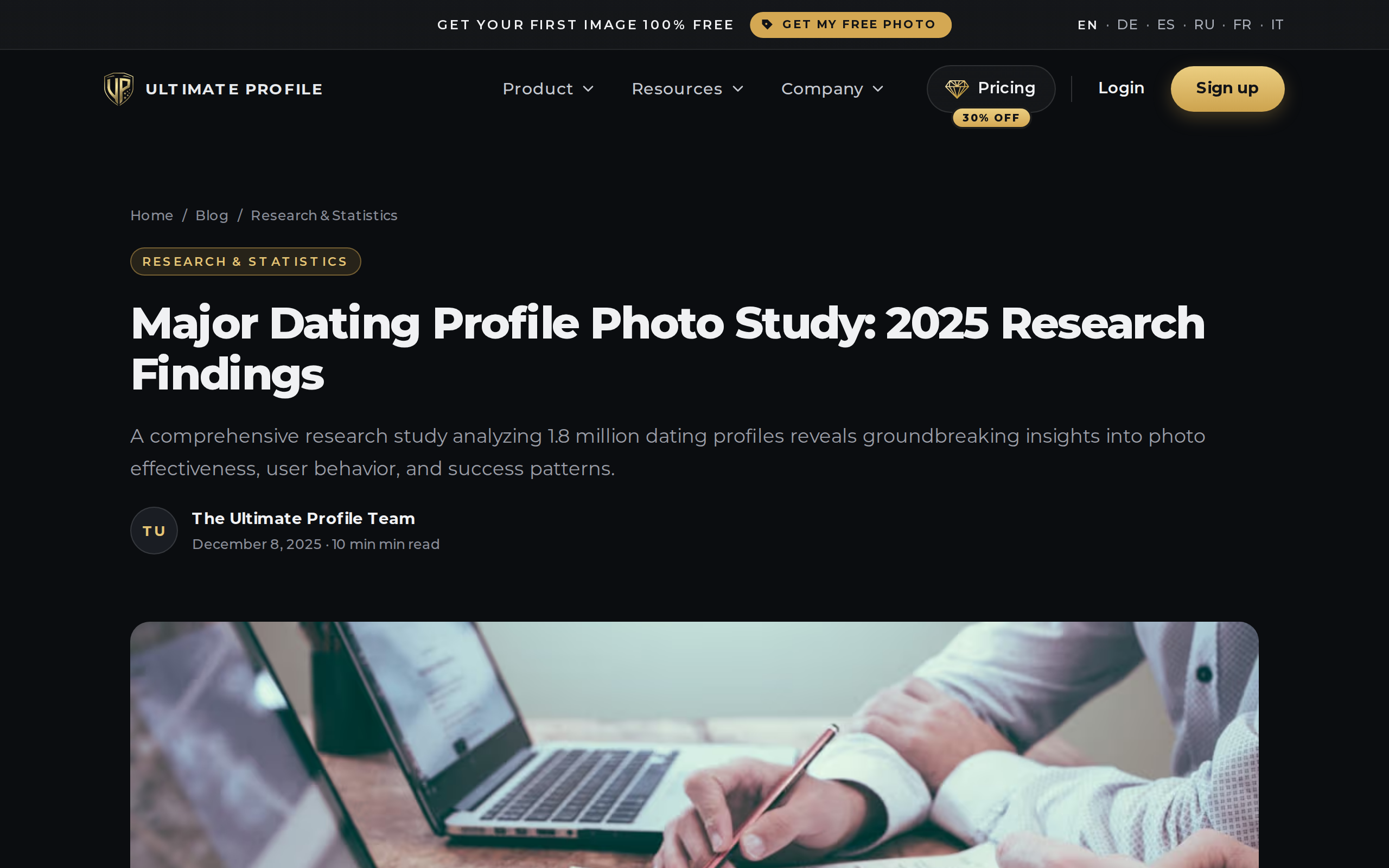
AURA reports a 34.2% match rate for its high-quality-photo group. Low-quality photos? 4.7%. That's a 7x multiplier sitting right there in your camera roll. And it gets worse (or better, depending on where you're starting). High-quality photos are 21x more likely to result in an actual scheduled date. 8.4% vs 0.4%. Let that hit you. Your crappy photos aren't just costing you matches. They're costing you actual dates with actual humans.
More figures from AURA’s own report, rather than SwipeStats measurements: 5-6 photos is the sweet spot, hitting a 28.9% match rate because it signals a "complete profile," which is why the best Tinder pictures come as a set rather than one lucky shot. Professional headshots deliver +178% more matches than casual selfies, which is the entire argument for hiring a dating profile photographer once instead of retaking selfies forever. Adding a full-body photo bumps your match rate by +203%. And here's the kicker: filtered photos tank your matches by 67%. Your Instagram filters are literally costing you dates. Stop it.
Our analysis of 7,000+ Tinder profiles and 294 million swipes confirms what every study shows. Photos are the single biggest variable in your match rate. It's not even close. The Tinder 80/20 rule is real. The top 20% of profiles (largely photo-driven) get 80% of the likes. If your photos suck, you're fighting for scraps with the other 80% of dudes. That's not a strategy. That's a support group.
How to Be Photogenic: 9 Tips That Don't Require a Jawline Transplant
Good news. You can learn how to be photogenic without surgery, a personal stylist, or selling your soul. Bad news. It takes actual effort. I know. Disgusting.
1. Show your left side.
Remember the left-side bias research? Your left cheek photographs more expressively and is rated as more appealing. Portrait painters figured this out before photography existed. Turn your body slightly so your left side faces the camera. It's free. It's backed by science. Do it.
2. The chin-forward trick.
Push your chin forward and slightly down. I know it feels stupid. It looks stupid when you practice in the mirror. But in photos, it elongates your neck, sharpens your jawline, and eliminates the double chin that makes every normal human look like they're storing acorns for winter. Every photographer on earth knows this. Now you do too.
3. The inhale trick.
Breathe IN right before the photo is taken. Not out. Inhaling naturally lifts your face, opens your shoulders, and elongates your neck. Exhaling drops everything and makes you look like a deflated balloon animal. This one tip alone will make you look 20% more alive in photos (not a real statistic, but I believe it in my soul).
4. Chase the light.
Golden hour (just before sunset) or overcast days. That's the sweet spot. Harsh midday sun creates unflattering shadows under your eyes and nose. Overhead fluorescent lighting makes literally everyone look like they're auditioning for a zombie movie. If every photo of you looks like a mugshot, it's probably the lighting, not your face.
5. Take 60 photos, keep 1.
Korean girls figured this out ages ago and the rest of us are still catching up. Even professional models have terrible shot-to-keeper ratios. The secret to great photos isn't looking great in every shot. It's taking enough shots that the math works in your favor. Volume shooting isn't vanity. It's statistics. And statistics don't care about your feelings.
6. Candid beats posed every time.
Research shows that when it visually looks like you tried hard, you're rated as less attractive. Stiff poses with that weird tight-lipped smile read as "my mom made me take this at Thanksgiving." Mid-action shots. Walking, laughing, turning around, looking at something off-camera. That's the stuff that reads as confident and natural. Fake candidness is still better than real stiffness. Fight me.
7. Back away from the camera.
I already told you about the 30% facial distortion from selfie cameras. The fix is embarrassingly simple. Have someone else take the photo from 2-3 meters away. Or use a timer and prop your phone on something. Your nose will immediately look like a normal human nose again instead of a Pixar character's. This single change will improve your dating profile photos more than any filter ever could.
8. Relax your face (seriously).
Camera anxiety triggers a genuine fight-or-flight response. Your shoulders hunch. Your jaw clenches. You get the deer-in-headlights stare that screams "I am being held at gunpoint." Warm up your facial muscles. Shake your head around. Think of something genuinely funny. Not "cheese." Think of that time your friend fell off the chair at brunch. A real laugh makes a real expression.
9. Dress for the camera, not the mirror.
Cameras add visual weight with bulky materials. V-necks elongate the neck. Figure-fitted clothes photograph better than baggy ones. Solid colors beat busy patterns. And for the love of everything holy, check your background before you hit the shutter button. Nothing kills a great photo faster than a pile of dirty laundry casually photobombing your profile picture from the corner.
The Photogenic Trap: When Your Photos Are Too Good
Here's the plot twist nobody asked for. You can actually be TOO photogenic for dating apps. A photographer friend once told me about a buddy of his. Pretty average-looking guy in person. Decent. Normal. But in photos? This dude looked like he was carved out of marble by someone who really liked jawlines. His dates were consistently disappointed meeting him in real life. He was basically reverse-catfishing himself.
Remember those filtered photo stats? 67% fewer matches. People can smell the dishonesty. Over-editing creates a gap between your "digital avatar" and your actual face. And when your match shows up for coffee expecting the person from the photos and gets someone who looks like their less-attractive cousin? There's not going to be a second date.
The goal of being photogenic isn't to become a different person. It's to be YOU on your best day, in the best light, at the best angle. Your dating profile needs to look like you, not the Pixar version of you. Not the FaceTuned version. Not the "I only exist in golden hour with a professional camera" version. You, but on a day when you slept well and remembered to put on a shirt that fits.
Authenticity wins. Every time. The person who swipes right on an honest photo of you is swiping right on YOU. The person who swipes right on an over-edited fantasy is swiping right on a fiction. And fiction has a really bad track record at dinner dates.
If you want to know how your current photos are actually performing, upload your data and let the numbers tell you what your friends are too nice to say.
FAQ: Quick Answers About Being Photogenic
What makes a face photogenic?
Facial symmetry helps. So does strong bone structure that creates shadows in 2D. But that's maybe 30% of it, and it's the part you can't change anyway (if you're curious where you land, our attractiveness test will tell you more bluntly than your friends will). The other 70% is technique. Lighting, angles, expression, and knowing which side of your face to show the camera. Plenty of "conventionally attractive" people take terrible photos because they never learned the basics. Plenty of average-looking people take incredible ones because they did.
Can you be attractive but not photogenic?
Absolutely. Cameras flatten 3D faces into 2D images. Features that look great in person (slight asymmetries that add character, dynamic expressions, the way your eyes crinkle when you laugh) can look weird in still photos. The reverse is also true. Some faces just happen to have proportions that cameras love. Neither version is more "real." They're just different mediums.
What's the opposite of photogenic?
"Unphotogenic" is the standard term. There's no widely-used single-word antonym. Some people say "camera-shy" but that describes discomfort, not result. You can be camera-shy and still photograph well. You can be totally comfortable and still look like a sleep paralysis demon in every shot.
What's a synonym for photogenic?
"Camera-ready" is the closest. "Telegenic" means the same thing but for TV and video. "Picture-perfect" works casually but sounds like something your aunt would write on a Facebook comment under a photo of her cat.
Can a non-photogenic person become photogenic?
Yes. That's literally the entire point of this article. Every photographer, YouTuber, and study I've referenced agrees. Being photogenic is a practiced skill. Learn your angles. Understand lighting. Take volume photos. Relax in front of the camera. If you do all of that consistently, you will look better in photos. It's not magic. It's not genetics. It's putting in the work.
Sources
- Epley, N., & Whitchurch, E. (2008). Mirror, Mirror on the Wall: Enhancement in Self-Recognition. Personality and Social Psychology Bulletin. https://journals.sagepub.com/doi/10.1177/0146167208318601
- Blackburn, K., & Schirillo, J. (2012). Emotive hemispheric differences measured in real-life portraits. Experimental Brain Research. https://www.sciencedaily.com/releases/2012/04/120420123847.htm
- Ferguson, A. (2024). Selfies have changed our perception of what we look like. Popular Science. https://www.popsci.com/technology/selfie-face-perception-distortion/
- AURA / The Ultimate Profile (2025). Dating Profile Photo Study: 1.8M Profile Analysis. https://www.theultimateprofile.com/en/blog/dating-profile-photo-study
About the Author
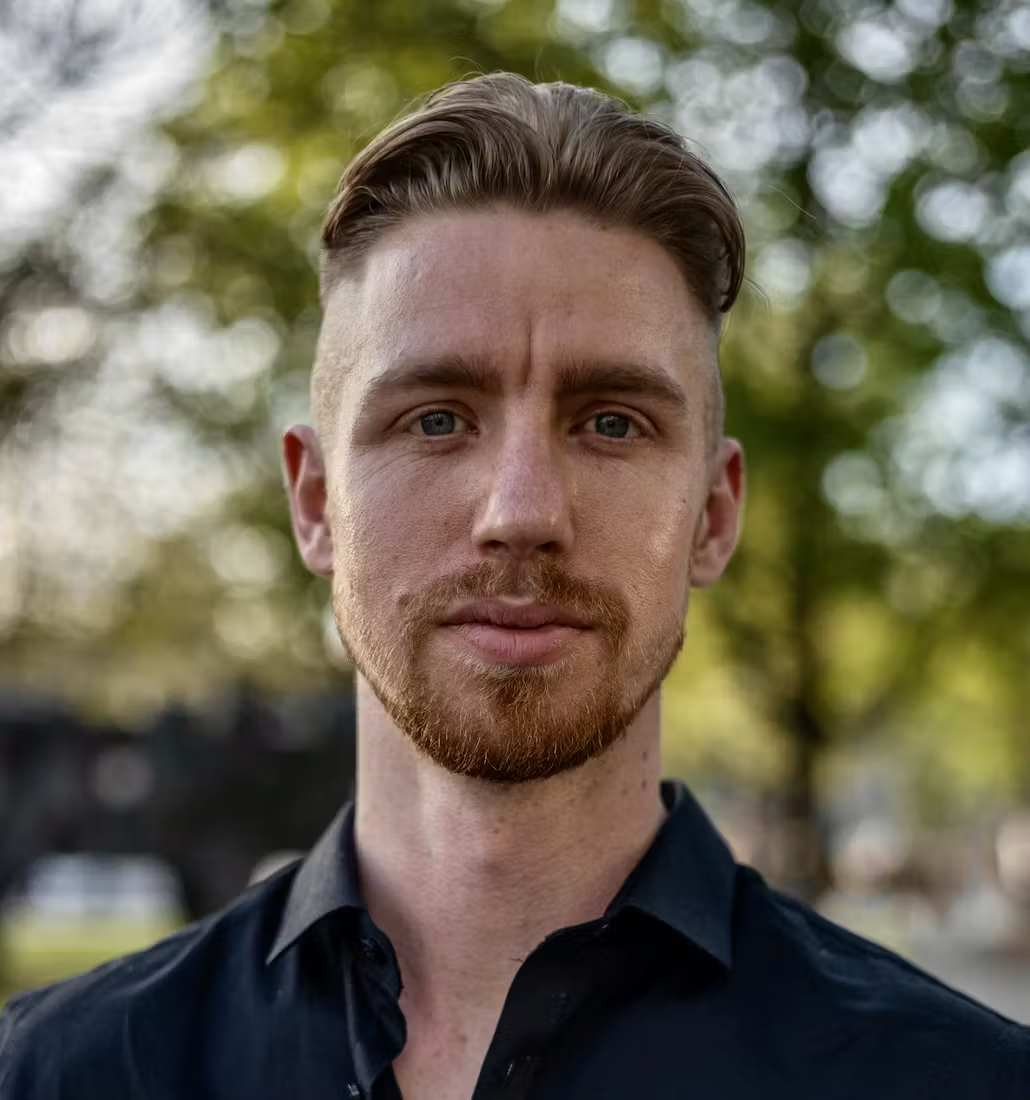
Also from Kristian: Homi is Kristian's AI workspace for organizing home searches with your partner, family, or agent.